What a 24-Hour Day Really Feels Like When You're Raising an Autistic Child
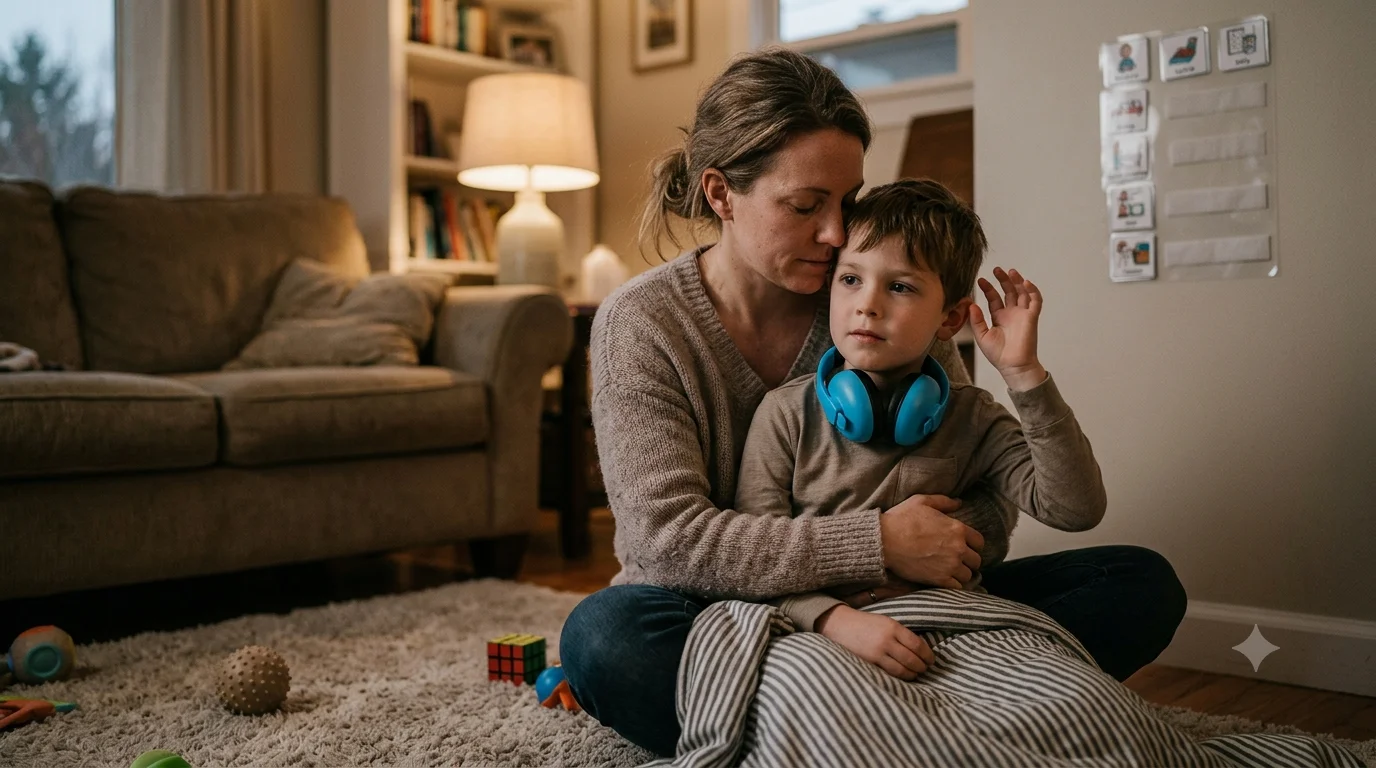
People ask what a “typical day” looks like when you’re raising an autistic child, and I never know how to answer in one sentence. So here it is in real time — not the highlight reel, not the tragedy story either. Just the hours, one after another, the way they actually happen in our house.
If you’re living some version of this too, I want you to read it and feel one thing above all: you are not imagining how hard this is, and you are not doing it wrong.
5:47 AM: The Day Starts Before My Alarm Does
I hear him before I hear my alarm. Not crying — humming. The same three notes, over and over, from the doorway of my room. That’s my signal. The day has already begun, whether my body is ready or not.
There is no snooze button in autism parenting. Sensory regulation doesn’t wait for coffee. So I’m up, checking his hands for the stimming that tells me how his nervous system woke up today — calm hands mean a gentler morning, tight fists mean I need to move slow and quiet for the next hour.
6:30 AM: A Morning Routine That Cannot Change
Same bowl. Same spoon. Same show playing at the same volume in the background. I used to think I was being rigid. Now I understand I’m building the only thing that makes mornings survivable: predictability.
One swapped sock, one skipped step in the visual schedule, and the whole morning can unravel into a meltdown before we’ve even left the house. So I plan the sequence the night before like I’m running a small, quiet military operation — because for a kid whose brain processes the world without the buffer most of us take for granted, that predictability isn’t a preference. It’s regulation.
8:15 AM: The School Drop-Off Nobody Prepares You For
I count his breaths in the backseat mirror the way other parents count red lights. Some mornings the transition into the building is smooth — a hand squeeze, a fast walk to his line, done. Other mornings it’s ten minutes in the car with noise-canceling headphones on, running through the same three calming phrases until his shoulders drop half an inch.
I’ve learned to read a hallway the way I used to read spreadsheets. Too many kids talking at once, a fire drill schedule I wasn’t warned about, a substitute aide who doesn’t know his cues yet — any of it can turn drop-off into a full sensory overload before 8:30 AM. I drive away most mornings not knowing which version of the day he’s about to have.
9:00 AM to 2:00 PM: The Quiet That Isn’t Really Rest
This is the stretch people assume is my “free time.” It isn’t. It’s IEP paperwork. It’s a call back from the speech therapist about adjusting his goals. It’s rescheduling the occupational therapy session that got bumped, again. It’s answering emails while half-listening for my phone in case the school calls.
Autism parenting has a second, invisible job title: case manager. Nobody hired me for it. Nobody trained me for it. But somewhere between the diagnosis and now, I became the person who tracks every therapy hour, every accommodation, every provider’s direct line — because if I don’t hold all of it, no one else will.
2:45 PM: The After-School Meltdown Nobody Warns You About
This is the hour that breaks parents who are doing everything right. It even has a name — therapists call it after-school restraint collapse. All day, he holds it together. He masks, he complies, he pushes through sensory input that would flatten most adults. And the second he sees my face at pickup, the mask comes off, all at once, usually in the car or on the front steps.
It looks like a meltdown. It is not a tantrum. A tantrum wants something. This wants nothing except to finally stop holding it together. I’ve stopped taking it personally. I’ve started treating those first twenty minutes home as the most important therapy of the day — dim lights, no demands, no questions about school. Just space.
4:00 PM: Therapy, Homework, and the Second Shift
Some days there’s ABA therapy. Some days it’s speech. Some days it’s both, wedged between a snack he’ll actually eat and a homework sheet that takes four times longer than it should because every transition between tasks is its own small negotiation.
I am, by 4 PM, a therapist, a translator, a scheduler, and still — somehow — supposed to be someone’s employee, someone’s partner, someone’s friend. I’ve stopped apologizing for how tired that makes me. Two full jobs in one body will do that to anyone.
6:00 PM: Dinner Is Never Just Dinner
Texture. Temperature. The plate has to be the right plate. One food touching another food can end a meal before it starts. I used to fight these preferences. Now I pick which battles are actually about nutrition and which ones are about sensory survival — and most nights, I let sensory survival win.
7:30 PM: Bath Time and Small, Real Victories
Water on his head used to mean screaming. Tonight he tipped his own head back and let me rinse the shampoo without flinching. I didn’t say anything. I just sat with that feeling for a second — because outsiders will never understand why a thirty-second bath moment can feel like the biggest win of my week.
8:30 PM: The Bedtime Routine That Takes an Hour on a Good Night
Weighted blanket, same three books, same song, same amount of pressure on his back until his breathing slows. Sleep doesn’t come easy for a lot of autistic kids, and it doesn’t come easy in our house either. Some nights it’s twenty minutes. Some nights it’s ninety. I stay until it’s done, because rushing this hour only means paying for it later, at 2 AM, wide awake.
11:00 PM: The Hours When the House Finally Goes Quiet
This is when I stop being anyone’s therapist and just sit with what the day actually was. I answer one more email. I refill the pill organizer. I let myself feel exhausted without immediately fixing it. This is also, most nights, when I cry — not because I regret this life, but because loving someone this much, this hard, all day, takes a kind of strength nobody sees and nobody claps for.
2:00 AM: Awake Again
Some nights he wakes up. Some nights it’s me, running through tomorrow’s therapy schedule in my head before I’ve even opened my eyes. Either way, I know the alarm — real or humming in the doorway — is only a few hours away.
What This 24-Hour Cycle Really Teaches You
It teaches you that strength isn’t one big moment. It’s a thousand small ones, stacked end to end, starting before sunrise and ending long after dark. It teaches you to measure a good day in inches, not miles — a calmer transition, a bite of a new food, a bath without a fight.
And it teaches you something most people never have to learn: that you can be completely, bone-deep exhausted, and still choose this life again tomorrow, without a single moment of regret.
Frequently Asked Questions
What does a typical day look like for a child with autism?
There’s no single “typical” day — every autistic child regulates differently — but most families build the day around predictable routines, visual schedules, and built-in downtime after high-demand periods like school. The common thread isn’t the schedule itself; it’s the structure and predictability behind it.
Why do autistic children have meltdowns right after school?
It’s often called after-school restraint collapse. Kids hold themselves together — masking, complying, managing sensory input — all day at school, and the moment they’re back in a safe space with a trusted parent, that effort collapses all at once. It’s a sign they trust you enough to fall apart, not a sign you’re doing something wrong.
Is it normal to feel exhausted all the time as an autism parent?
Yes. Autism parent burnout is real and well documented — the constant vigilance, scheduling, advocacy, and sensory-aware caregiving adds up to a workload most people never see. Feeling exhausted doesn’t mean you’re failing; it means you’re carrying a genuinely heavy, mostly invisible load.
How can I build a daily routine that actually helps my autistic child?
Start small: a visual schedule for mornings, a consistent order for daily tasks, and a decompression window built into transitions (especially right after school). Predictability — not perfection — is what reduces meltdowns over time.
How many hours of therapy does a child with autism typically need each week?
It varies widely by child and by plan — some kids receive a few hours a week of speech or occupational therapy, others have more intensive ABA schedules. The right amount is the one your child’s care team builds around their specific goals, not a number you compare against another family.
Conclusion: One Day, Repeated With Love
A 24-hour day raising an autistic child doesn’t look like anyone else’s day. It’s longer in the hard parts and richer in the small parts. It asks more of you before 9 AM than most people give in a week, and it hands back rewards that don’t show up on any normal timeline — a head tip in the bath, a hand squeeze at drop-off, three calm breaths in the backseat mirror.
If today was hard, that doesn’t mean you did it wrong. It means you did it — start to finish, hour by hour, the only way this kind of love actually works. Tomorrow, the alarm — or the humming in the doorway — will come again. And you’ll get up again, too.
Comments