Don't Call It Picky Eating: Safe Foods Are How My Autistic Child Finds Comfort
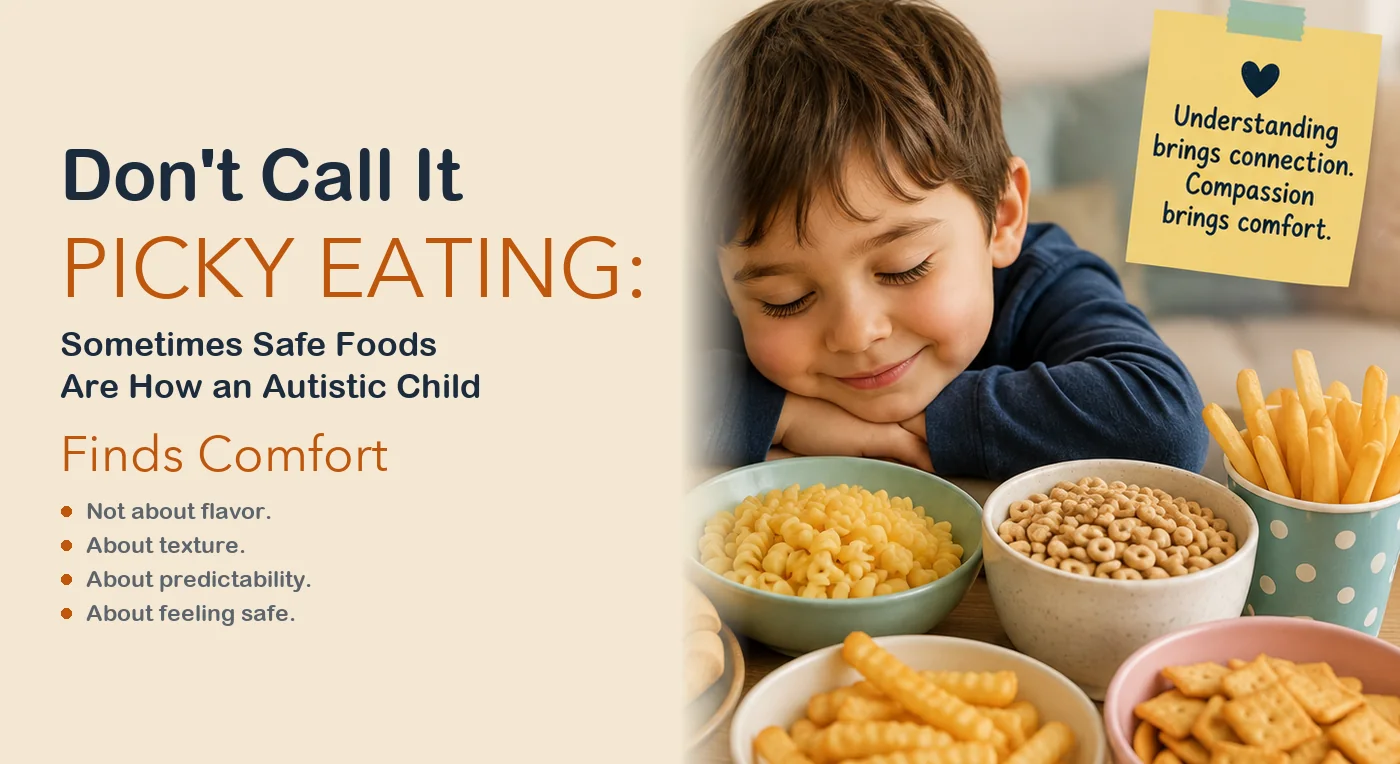
My son has eaten the same lunch for two years and four months.
Plain pasta, no sauce, the spiral kind. A handful of Cheerios in a separate bowl. Six chicken nuggets — one brand, and if the shop is out of that brand we do not substitute, because a substitute is not a smaller problem, it is a different food entirely.
I know exactly what people think when they see that plate. I used to think it too, before it was my plate to make. I thought: she’s giving in. He’d eat something else if he got hungry enough.
He wouldn’t. I know that now with a certainty I’ve paid for. And somewhere along the way I stopped calling it picky eating, because that phrase describes a preference, and this has never been a preference.
“Picky” Describes a Choice. This Isn’t One.
A picky eater doesn’t like broccoli. Offer it enough times, in enough forms, with enough patience, and a fair number of picky eaters come round. That’s the standard advice, and for a lot of children it works — I’ve written up the usual toddler picky eating strategies elsewhere, because they’re genuinely useful for the children they were written for.
They were not written for my son.
When he encounters a food outside his set, what happens is not reluctance. It’s gagging. Retching. Sometimes tears, sometimes a full shutdown that ends the meal for everyone. His body treats an unfamiliar texture in his mouth roughly the way yours would treat a mouthful of sand — as something to be expelled, immediately, without consulting him first.
That is not a negotiation I can win with a sticker chart. And every time I tried, I taught him that the dinner table was somewhere he had to defend himself.
Research backs up the scale of this. A widely cited meta-analysis found that autistic children are around five times more likely to have significant feeding difficulties than non-autistic children. Estimates of how many autistic kids have some degree of restricted eating run from about 45% to as high as 90% depending on how you define it. This is not a handful of unusually stubborn families. It’s close to the norm.
What a “Safe Food” Actually Is
In the autistic community, the term is safe food, and it’s exact.
A safe food is one that is reliably the same every single time. Same texture, same temperature, same smell, same appearance, same amount of resistance when you bite it. It carries no risk. Eating it requires no bravery and no information-gathering. In a day that is otherwise full of unpredictable sensory input, it’s a small guaranteed thing.
That last part is the bit most people miss. Safe foods aren’t just tolerated — they’re often actively regulating. Plenty of autistic adults describe returning to a safe food the way other people describe a hot bath after a hard day. The predictability itself is the comfort. The flavour is almost beside the point.
Which is why “but he likes it, he ate it last week” and “he’s just being difficult” both miss so badly. He isn’t chasing a taste. He’s reaching for the one input in his day that will not surprise him.
The Foods Autistic Kids Gravitate To — and Why
Walk into any autism parenting group and the same foods come up again and again:
- Plain pasta, no sauce — often one specific shape
- Chicken nuggets, and usually one brand
- French fries and potato chips
- Cheerios and other dry cereals, frequently eaten dry
- Plain white bread, crusts off
- Crackers — saltines, Ritz, plain water biscuits
- Cheese, especially string cheese and mild sliced cheese
- Plain rice
- Apples or bananas, but only at a specific ripeness
- Yogurt, smooth only, no fruit pieces
- Waffles and pancakes, dry, no syrup
- Peanut butter, smooth — never crunchy
This list is oddly consistent across thousands of families, and once you see why, it stops looking like a coincidence and starts looking like a specification.
They’re texturally uniform. Every bite of a cracker is the same as the last. A casserole is a different experience every forkful, and for a mouth that reads texture in high definition, that’s genuinely unpleasant.
They’re mass-produced, so they’re identical. This is the underrated one. A chicken nugget from a big brand is engineered to be the same in Ohio and in Manchester, in March and in November. Home-cooked chicken is never the same twice. That industrial consistency is exactly what a child seeking predictability needs — which is why parents get told they’re feeding their kid “junk” when they’ve actually found the only reliably identical protein in the shop.
They’re mostly dry, crunchy, or smooth. Two textures autistic kids commonly manage. What tends to get rejected is mixed texture — soup with bits in, yogurt with fruit, anything wet-and-lumpy at once.
They’re beige. Partly because beige foods are the dry, uniform ones. Partly because strong colours often come with strong smells and sharper flavours.
They don’t smell much. Oral sensitivity travels with smell sensitivity. A food that announces itself from across the room has already been rejected before it reaches the plate.
They look the same every time. Which is why a brand redesigning its packaging can end a food. The child isn’t being irrational — they identified that food partly by the box, and now something about it has changed, so it may not be the same thing inside.
It’s Not About Flavour. It’s About Texture, Predictability and Regulation.
If you take one thing from this: taste is rarely the issue.
Texture is the most commonly reported driver of food refusal in autistic children — the mouthfeel, the resistance, the way a food breaks apart. A child who refuses cooked carrots may eat raw carrot sticks happily. Same flavour. Completely different physical event.
Then there’s temperature, which is stricter than most people realise — some kids will only eat food at room temperature, and a plate that’s slightly too warm becomes inedible.
There’s the contamination problem, where foods touching on the plate ruins both. This is not fussiness about presentation. Once the sauce has touched the chips, the chips have become a new, unverified food.
And there’s interoception — the internal sense that tells you you’re hungry, full, thirsty, or need the loo. Many autistic people have a less reliable interoceptive sense, which means hunger signals can arrive late, faintly, or as a vague unpleasantness rather than a clear “I should eat”. A child who genuinely cannot feel hunger building is not going to be motivated by the classic “he’ll eat when he’s hungry.”
Put those together and mealtimes stop looking like a behaviour problem and start looking like what they are: a sensory event that a child is trying to survive, several times a day.
When It’s ARFID, Not Preference
There’s a name for the more severe end of this, and it’s worth knowing: ARFID — Avoidant/Restrictive Food Intake Disorder. It’s a recognised eating disorder in the DSM-5, and it co-occurs with autism at high rates.
ARFID is not about body image or weight. It’s restriction driven by sensory sensitivity, lack of interest in eating, or fear of a bad outcome like choking or vomiting. The distinction that matters is impact: ARFID is diagnosed when the restriction is significant enough to cause weight loss or faltering growth, nutritional deficiency, dependence on supplements, or serious interference with daily life.
Knowing the term changed things for us, because it gave me something to say to professionals that got taken seriously in a way “he’s a really picky eater” never did.
Being Honest About the Risks
I’m not going to write a piece telling you safe foods are entirely fine and then leave out the part where they need watching. That would be doing you a disservice.
A very narrow diet does carry real nutritional risk. The common gaps are fibre, vitamin C, vitamin D, iron, zinc and calcium — and constipation is extremely common, which matters because constipation makes a child feel unwell and eat even less, and the loop tightens. If iron is a concern, our guide to iron-rich foods for toddlers has options, though you’ll be looking for whichever ones fit inside the textures your child already accepts.
At the far end, there are documented medical case reports of children with extremely restricted diets developing scurvy or vision problems from vitamin deficiency. These are rare. They are also real, and they’re the reason “just let him eat what he wants and don’t worry about it” is not adequate advice on its own.
Talk to a professional if: your child is losing weight or falling off their growth curve; they’re dropping foods without adding new ones; they eat fewer than around 20 foods in total; you’re seeing signs of deficiency like fatigue, bruising, or unusual pallor; or mealtimes are causing serious distress to your child or your family.
Ask specifically for a referral to a feeding team — usually some combination of a speech and language therapist, an occupational therapist and a dietitian. A generalist telling you to “keep offering” is not the same as a sensory-informed feeding assessment.
What Has Actually Helped Us
Safe foods stay on the table. Always. This is the foundation and I will not compromise on it. Removing a safe food to force variety doesn’t create variety — it creates a child who now doesn’t trust mealtimes and has one fewer thing to eat. Every new food is offered alongside, never instead of.
No pressure. None. No “just one bite”, no rewards for tasting, no waiting until it’s finished. Pressure reliably makes restricted eating worse, and it costs you the thing you most need: a child who is relaxed enough to be curious.
Food chaining, slowly. Start from a safe food and move one variable at a time. If he eats one brand of nugget, the next step isn’t fish — it’s a different nugget of the same shape. Then a slightly different shape. It’s tedious and it takes months, and it works far better than a leap.
Exposure without eating. Touching, smelling, playing, helping to cook, having it on the table across the room. Getting comfortable with a food is a long process that happens well before anything goes in a mouth — this is really just sensory play applied to dinner.
Fortifying what he already eats. Adding a little more where I can, inside the textures he accepts. A dietitian is worth their weight in gold for this, because they’ll find options I’d never have thought of.
Stockpiling. When a food he eats gets a “new recipe!” flash on the packet, I buy what’s left of the old stock. This sounds mad and it is the most practical advice in this article.
Not fighting in public. The relatives’ comments at family meals are their own thing entirely, and I’ve made my peace with not explaining my parenting to people who haven’t lived it.
What I’d Say to Someone at the Start of This
You have not failed at feeding your child. The advice you were given didn’t work because it was written about a different problem.
The reframe that helped me most was this: my job is not to expand his diet by Friday. My job is to keep the table a safe place, protect the foods he has, and add slowly from there — over years, not weeks. Some of it will come. Plenty of autistic adults eat a much wider range than they did at six, and plenty still have safe foods they return to, and there is nothing wrong with either outcome.
He is fed. He is growing. He is not anxious at dinner. That’s the win, and it took me a long time to let it be enough — which is really the same lesson as not needing to be a perfect parent, just served on a plate with a compartment divider.
Frequently Asked Questions
What are safe foods in autism?
Safe foods are foods an autistic person can rely on to be exactly the same every time — same texture, smell, appearance and temperature. Because they’re completely predictable, eating them requires no risk assessment, which makes them regulating as well as nourishing. Common examples are plain pasta, chicken nuggets from one specific brand, fries, dry cereal like Cheerios, crackers, plain bread and cheese.
Why does my autistic child only eat beige foods?
Beige foods tend to be dry, texturally uniform, mildly flavoured and low in smell — the exact profile that’s easiest for a sensitive sensory system to manage. They’re also usually mass-produced, so each one is identical to the last. It isn’t a colour preference so much as a side effect of what those foods have in common.
Is autistic food refusal the same as picky eating?
No. Picky eating is a preference that often responds to repeated exposure and patience. Autistic food refusal is usually a sensory response — gagging, retching or shutdown that the child doesn’t control — and standard picky-eating advice frequently makes it worse by adding pressure. Autistic children are roughly five times more likely than others to have significant feeding difficulties.
Should I take away safe foods to make my child try new things?
No. Removing safe foods doesn’t create variety; it removes security and typically narrows the diet further while damaging trust at mealtimes. Keep safe foods consistently available and introduce new foods alongside them, with no requirement to eat.
What is ARFID and how is it linked to autism?
ARFID (Avoidant/Restrictive Food Intake Disorder) is a recognised eating disorder involving restricted intake driven by sensory sensitivity, low interest in food, or fear of consequences like choking — not by body image. It co-occurs with autism at high rates and is diagnosed when restriction causes weight loss, nutritional deficiency, supplement dependence or major disruption to daily life.
When should I worry about my autistic child’s limited diet?
Seek help if your child is losing weight or falling off their growth curve, is dropping foods without adding new ones, eats fewer than about 20 foods, shows possible deficiency signs like fatigue or unusual bruising, or if mealtimes are causing significant distress. Ask for a referral to a feeding team — typically a speech and language therapist, occupational therapist and dietitian.
Should I give my autistic child a multivitamin?
Often reasonable as a safety net for a narrow diet, but check with your pediatrician first rather than choosing one yourself. They can advise on what’s actually likely to be short, whether bloodwork is worth doing, and which format your child will accept — a chewable your child gags on is not a supplement.
Will my autistic child’s diet ever expand?
Frequently, yes — but on a timescale of years rather than weeks, and usually through gradual steps from foods already accepted rather than sudden leaps. Many autistic adults eat a much wider range than they did in childhood while still keeping safe foods they return to when stressed. Both of those are fine outcomes.
Conclusion: Understand It Before You Try to Fix It
The phrase “picky eater” puts the problem in the child and the blame in the parent. It suggests a will that needs breaking, and it has sent an enormous number of families into years of mealtime battles that made everything worse.
What’s actually happening is quieter and more reasonable than that. A child with a sensory system that reads texture, smell and temperature at full volume has found a handful of things that never surprise him, and he holds onto them. Those foods are not a limitation he needs talked out of. They’re a coping strategy that’s working.
Watch the nutrition. Get the referral if the signs are there. Add new foods gently, one variable at a time, for as long as it takes.
But before any of that — stop calling it picky. Start asking what makes those particular foods feel safe. The answer to that question is where every useful thing you do next is going to come from.
Comments