When My Child Cries and I Don't Know Why
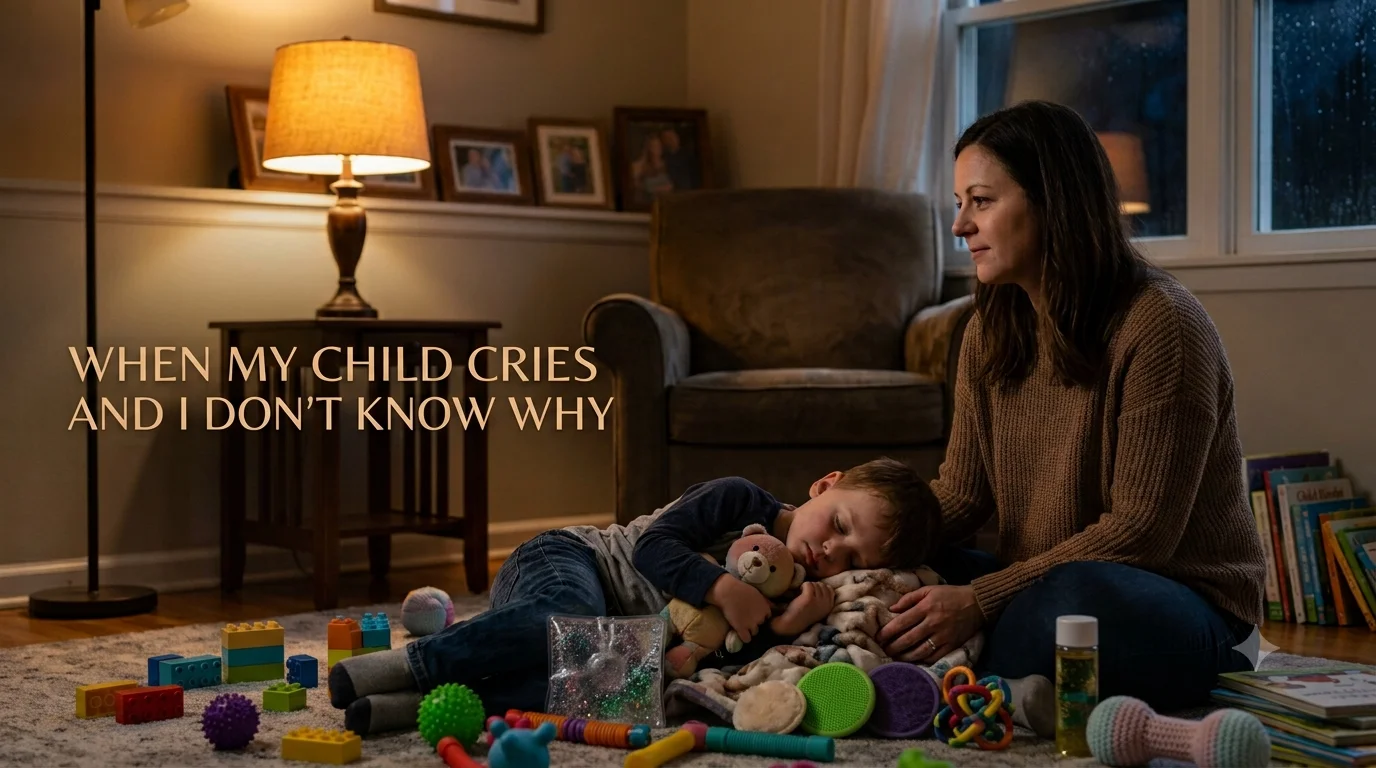
There is one question that follows me through my days as an autism mom: What is my child trying to tell me?
I ask it when my child cries unexpectedly. I ask it during meals when food gets refused. I ask it at night when sleep won’t come. I ask it in the moments I can see my child struggling and still can’t find the reason. If my child could say it out loud, I would listen for hours — whether something hurts, whether the world feels too loud, whether it’s fear or hunger or something I haven’t thought of yet. But my child doesn’t communicate in words, so I’ve learned to listen a different way: with my eyes, for the small changes in expression, sound, and routine that tell me something a sentence never could.
Quick Takeaways
- A cry from a nonverbal child is communication, not misbehavior — it’s usually the clearest signal available in that moment
- Common causes include discomfort, sensory overload, pain, fatigue, and a need that has no other way to get expressed
- Not knowing the reason for a cry is not the same as not knowing your child — some days there simply isn’t a clean answer
- The exhaustion of constantly interpreting behavior is real and separate from the physical demands of caregiving
- Small, quiet moments of connection are still real progress, even when they look ordinary from the outside
The Reality of Loving a Child You Can’t Always Understand
Before becoming an autism parent, I never realized how much we lean on words. When a child falls, we ask, “Where does it hurt?” When a child is upset, we ask, “What happened?” Those questions feel automatic — until you have a child who can’t answer them, and you have to find another way in.
So I’ve become someone who studies my own child every day. Not to analyze every moment, but to understand the person I love more than anything. I notice the difference between a happy sound and a frustrated one. I notice when something is being avoided. I notice when an ordinary day suddenly feels different underneath.
Some days I get it right. Sometimes I understand exactly what’s needed. But sometimes I try everything and still don’t know. Those are the moments that hurt the most — not because I’m not trying, and not because I don’t know my child, but because I love my child enough to want to solve every problem, and some days I simply can’t.
When A Cry Becomes a Message
For many families, a cry means something simple: attention, hunger, tiredness. For parents of nonverbal autistic children, a cry can feel like a message written in a language you’re still learning to read. It might mean I’m uncomfortable. Or I can’t handle this feeling. Or something changed and I don’t know how to show it. Or, simplest and hardest of all: I need help.
The behavior on the outside is often a signal coming from somewhere on the inside — a body that’s overwhelmed rather than a child being difficult on purpose. That shift changed my parenting more than almost anything else. Instead of only asking “How do I stop this?” I started asking “What is my child experiencing right now?” It doesn’t fix everything. But it changes how I respond, and my child feels the difference even without words for it.
The Small Moments That Become Big Challenges
Things that look simple in other families can take real thought in ours. A meal isn’t always just a meal. Is it the taste? The texture? The smell? Is my child trying to tell me something I still can’t read? I don’t get to just ask. I observe, I try, I adjust — and when something new gets accepted, even something small, it means more than it would look like to anyone watching from outside.
Sensory sensitivity is often underneath more of this than it first appears — sound, texture, light, and smell can all tip a normal moment into distress well before a cry starts. Building sensory play into ordinary days has helped us practice handling that input at home, in small doses, before it has to happen somewhere harder — a grocery store, a birthday party, a waiting room.
The Quiet Exhaustion Autism Parents Carry
There’s a tiredness that comes from constantly thinking, separate from the physical work of caregiving. After my child finally falls asleep, my mind doesn’t always turn off. I replay the day. What worked. What didn’t. Whether I missed a sign. What tomorrow might bring.
People see the love we give our children. They don’t always see the invisible work underneath it — the observing, the learning, the worrying, the adjusting, the trying again tomorrow. It’s the same weight other autism parents describe feeling isolated by — not because the love isn’t enough, but because so much of the labor is invisible to everyone except the parent doing it.
The Hard Decisions We Make Because We Love Them
Some of the hardest parenting moments come from making choices for a child who can’t tell you what they want. Giving medicine. Sitting through appointments. Making a call and hoping it’s the right one. When my child cries through those moments, it can be heartbreaking, because I know the intention behind it isn’t always understood in the moment. I wish my child knew: I’m doing this because I love you. I’m trying to protect you. I’m trying to make things better.
The Fear I Don’t Always Say Out Loud
Like a lot of autism parents, I carry fears about the future. Who will understand my child the way I do. Whether the world will be patient. Whether the people who come after me will show up the way I have. These thoughts don’t come from believing my child is less — they come from my child meaning everything to me, and from wanting the world to meet that with acceptance instead of assumption.
The Moments That Remind Me Why I Keep Going
Even on the hardest days, there are moments that fill my heart back up: a smile, a laugh, a new skill, a moment my child reaches for me and I know it was on purpose. These might look ordinary to someone else. To me, they’re the memories I hold onto tightest.
Autism has taught me to notice things I might have overlooked before. A small step forward is still a step forward. A small connection is still a connection. Progress doesn’t have to be loud to matter — a lesson I keep relearning, along with everything else this journey has taught me about patience and love.
To The Parent Wondering If They’re Doing Enough
If you’re raising a nonverbal autistic child and some days feel like guesswork, you’re not alone in that. Plenty of parents have cried quietly, questioned themselves, and wished for a moment where they had every answer. The truth is no parent has all of them. We learn our children one day at a time. We get it wrong sometimes. We keep showing up anyway. That’s what the love actually looks like, even on the days it doesn’t feel like enough.
Frequently Asked Questions
What is the hardest part of raising a nonverbal autistic child?
Most parents point to not knowing exactly what their child is feeling or needing in a given moment. Learning to read communication that isn’t spoken takes time, and some days still end without a clear answer.
Can nonverbal autistic children communicate?
Yes. Communication can happen through gestures, expressions, sounds, movements, behavior, and tools like AAC devices or picture systems — speech is only one channel among several.
Why does my nonverbal autistic child cry without an obvious reason?
Crying can signal discomfort, sensory overload, pain, fatigue, or a need the child has no other way to express. It’s rarely “no reason” — it’s usually a reason that hasn’t been identified yet.
Do other autism parents feel overwhelmed by this kind of guessing?
Very often. The constant interpreting and adjusting creates a mental exhaustion that’s separate from — and sometimes heavier than — the physical demands of caregiving.
Conclusion
My child may not communicate the way I once imagined. But my child communicates — through every sound, movement, and moment of connection, each one part of the same story. Being an autism mom has taught me that understanding doesn’t always come from words. Sometimes it comes from patience. Sometimes from paying attention. Sometimes from simply staying in the room.
I may not always know why my child cries. But I know my child is loved, and every day I’ll keep learning the language only the two of us share.
Sources:
- Centers for Disease Control and Prevention (CDC) — Autism and Developmental Disabilities Monitoring (ADDM) Network
- American Academy of Pediatrics (AAP) — Autism Spectrum Disorder communication and family support guidance
- Autism Speaks — Nonverbal autism and alternative communication resources
Comments