My Child Doesn't Say “I Love You,” But I Know They Do
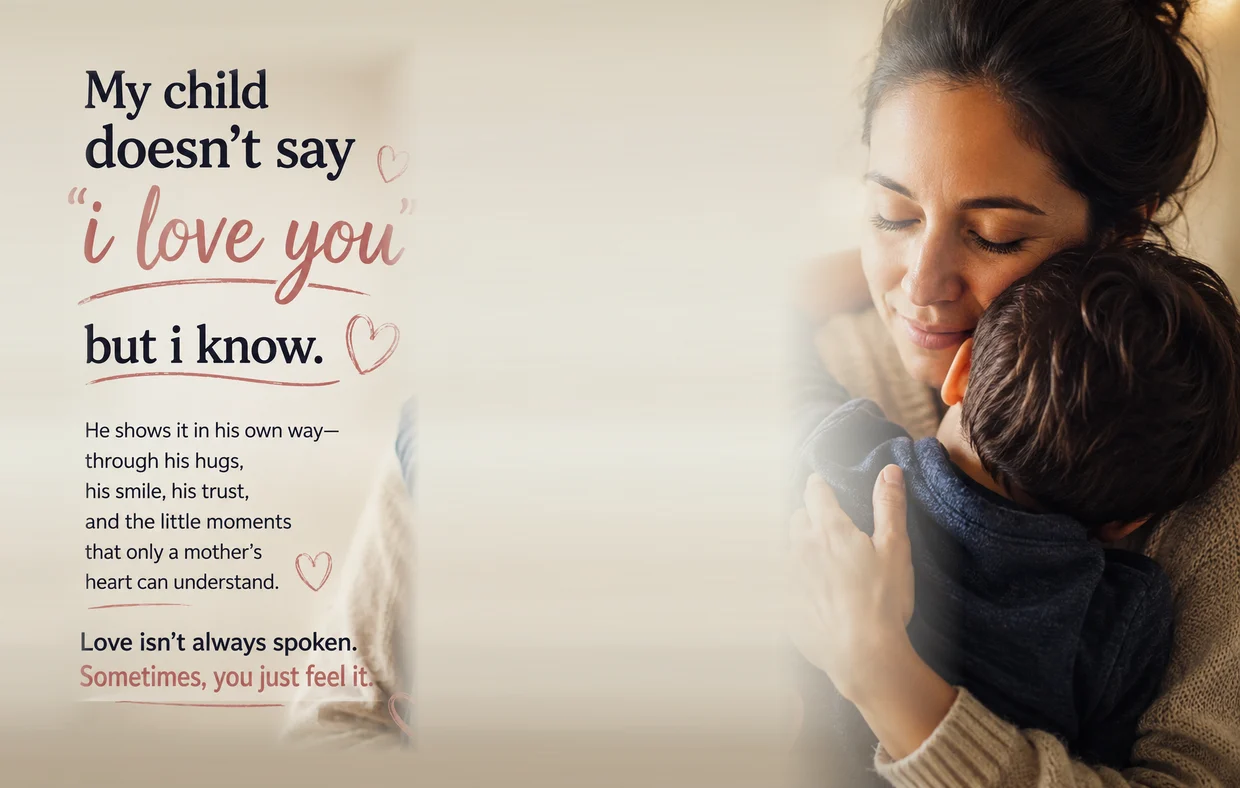
My son is four years old.
I have told him I love him every night of those four years. I worked it out once, sitting up late doing pointless math the way you do at 2am — somewhere past fourteen hundred times.
He has never said it back. Not once, not in words.
For years I thought that meant I was waiting. That somewhere ahead of us was a night when it would finally come, and everything I’d been carrying would set itself down.
I don’t think that anymore. Not because I gave up on him — because I finally learned to read what he’d been telling me the whole time, in a language nobody had thought to teach me.
But I want to be honest before we go any further: it hurt. It still does, some days. If you came here carrying that same ache, I’m not going to talk you out of it.
Quick Takeaways
- Autistic children who don’t speak, or don’t use words the expected way, still form deep attachments — connection and language are separate skills
- Love often shows up as proximity, sharing a special interest, using you to solve problems, or regulating only in your presence
- Saving meltdowns for you is one of the strongest signs of trust, not a sign your child is hardest on the person they love least
- Grieving the words you may never hear does not mean you love your child less or wish they were different
- Many autistic people describe loving intensely while being unable to express it in the way others expect
The Question That Broke Me
A friend asked me once, gently, the way people do when they think they’re being kind: “But does he know you’re his mom? Does he love you?”
I said yes. I smiled. I changed the subject.
Then I sat in my car outside the coffee shop and cried until my chest hurt.
Because here’s the thing. I did know the answer. I knew it in my body. But I had no proof I could hand her. No moment I could describe. No small voice saying the words back to me at bedtime the way she’d heard from her own children.
And a small, terrible part of me had been asking myself the same question at 2am for two years.
If that question lives in you too — you are not a bad parent for it. You are a parent who loves someone and can’t hear the echo.
Nobody Warns You About the Ordinary Moments
The diagnosis appointment is hard, but you brace for it. Nobody braces you for a Tuesday at the grocery store.
A little girl, maybe three, spotted her mother two aisles over and shouted “MOMMY!” and ran at her like she’d been apart for years. The mom rolled her eyes, laughed, scooped her up.
I stood there holding a box of cereal with my son beside me, not looking at me, running his fingers along the shelf edge because he liked how it felt.
That mother had no idea she’d just handed me the hardest thirty seconds of my week.
It’s the birthday cards signed in someone else’s handwriting. The Mother’s Day craft the aide made because your child wouldn’t. The family videos where every other cousin is calling for their parents. The bedtime where you say it and wait, one more time, in case tonight is the night.
You go on loving into what feels like silence. And you keep going. But it costs something, and I’m not going to pretend it doesn’t.
What Nobody Told Me: Connection and Language Are Different Skills
This is the thing I most wish someone had said to me early, plainly, in the first year.
Speech is not love. Speech is a motor and cognitive skill — mouth, breath, timing, word retrieval, and the ability to do all of it under pressure, in the moment, on demand. Attachment is something else entirely, and it lives somewhere much older and deeper.
A child can be profoundly, securely attached to you and have no reliable way to say so. Those two facts sit side by side without contradicting each other.
Autistic adults say this constantly, and we should listen to them more than we listen to well-meaning people who have never lived it. Many describe feeling love with overwhelming intensity — and being completely unable to produce the expected performance of it at the expected moment. Some describe the words feeling hollow or inaccessible precisely because the feeling is so big.
The love was never missing. I was reading for it in the one language my son didn’t have.
The Ways He Was Telling Me All Along
Once I stopped waiting for the sentence, I started noticing the vocabulary. Here is what I’d missed.
He brings me the thing he loves most. Not to hand over — just to show me, then take it back. For a long time I thought nothing of it. Sharing a special interest is one of the most vulnerable things an autistic person can do. He was letting me into the best room in his mind.
He backs into my lap. Doesn’t climb on, doesn’t face me. Reverses in like a little truck and settles against my chest. It took me two years to understand that he wants the contact without the overwhelm of a face right in front of his.
He takes my hand to what he needs. For ages I heard this described as a deficit — “using you as a tool.” But think about what it means. Out of everyone in the world, I am the one he brings his problems to. I am the reliable solution. That is trust in its most practical form.
He falls apart with me, and only me. He held it together all morning at preschool. The second he saw me in the doorway, he collapsed into a meltdown. It took a wise therapist to reframe it: he’d been coping and holding on for hours, and my arrival was the signal that it was finally safe to stop. Children don’t unravel in front of people they don’t trust. If you get the worst of your child’s day, it’s because you are the safest place in it. That reframe is one of the things this journey teaches you that nobody puts in the pamphlets.
He checks that I’m still there. Walks into the room, glances at me, walks out. Twenty times a day. He doesn’t want to play. He wants to confirm I haven’t gone anywhere.
He’s calm near me. This one is easy to miss because it’s an absence, not an event. His body settles when I’m close. The nervous system doesn’t lie about safety.
He repeats a line from a show. Same one, always at bedtime. It took me a long time to hear it as what it was — the closest thing he has to a word for this feeling. Scripting isn’t empty. It’s borrowed language for something real.
He lets me cut his hair, and no one else. Whole categories of touch he can’t tolerate from anyone — but he’ll tolerate them from me. That isn’t habit. That’s a decision his body makes about who is safe.
He flaps when he sees me. Not at anyone else. Just me, at pickup. That is joy, and it’s completely undisguised. It’s the most honest greeting I have ever received from another human being.
None of that is consolation-prize love. That’s the real thing, expressed fluently — I just had to learn to read.
About the Grief
I want to say this part carefully, because I think we skip it too fast.
You’re allowed to grieve the words.
There’s a particular guilt that comes with mourning something while your child is right there, alive and healthy and yours. It feels like a betrayal to want something more from them. Like admitting they’re not enough.
It isn’t that. Wanting to hear “I love you” isn’t wanting a different child. It’s wanting the specific, ordinary, human thing that almost every other parent gets for free. You can hold that ache and adore your child completely at the same time. Most of us do, every single day.
What helped me was letting the grief be about me instead of about him. He isn’t missing anything — he’s whole. I’m the one who wanted the sentence. Once I stopped making my sadness his responsibility, I could feel it without it curdling into disappointment in him.
And it does get quieter. Not gone. Quieter. Some days it comes back hard — a video, a cousin’s birthday party, a stranger’s toddler in a supermarket — and that’s allowed too. If it’s been one of those weeks, you’re not the only one carrying it.
If the Words Do Come
Sometimes they do. Sometimes at four, sometimes at nine, sometimes never in speech but one day typed, or signed, or pointed to on a device.
I know families where it arrived years after everyone stopped expecting it. I also know families where it never arrived in words at all, and those parents are not living smaller lives. They learned to read their child’s actual language and stopped requiring a translation.
If you’re still waiting, keep talking to your child. Keep narrating, keep saying it at bedtime, keep leaving the door open. Not as a transaction — you’re not depositing words to withdraw them later. You’re doing it because they’re absorbing far more than they can give back right now, and because the words that eventually come often arrive with no warning at all.
Say it because it’s true. Not because you need it returned.
Frequently Asked Questions
Do autistic children feel love?
Yes. Autism affects how a person communicates and processes the world, not their capacity for attachment. Many autistic people describe experiencing emotion, including love, very intensely — while finding the expected outward expressions of it difficult, uncomfortable, or inaccessible. Difficulty showing love and inability to feel it are completely different things.
How do autistic children show love?
Often through actions rather than words: staying physically near you, bringing you objects related to a special interest, taking your hand to solve a problem, regulating or calming in your presence, seeking pressure or specific kinds of touch, repeating a meaningful phrase, checking that you’re still in the room, or simply being visibly more relaxed when you’re close.
Why does my autistic child act worse with me than with anyone else?
Usually because you’re the safest person in their life. Many autistic children hold themselves together through school or social settings and release everything once they reach a person they trust. Getting the hardest part of your child’s day is a sign of security, not of failing them.
Will my nonverbal autistic child ever say “I love you”?
Some do, sometimes years later than expected, and sometimes through AAC devices, typing, or sign rather than speech. Others never say it in words. Speech development varies enormously and isn’t a measure of attachment. Communication support such as PECS or an AAC device can open a route to expression that speech alone doesn’t.
Is it normal to grieve that my child doesn’t say it back?
Completely. Grieving an expression of love you hoped for isn’t a rejection of your child, and it doesn’t mean you love them less. Nearly every parent in this position feels some version of it, most of them quietly and with a lot of unnecessary guilt attached.
How can I encourage my child to express affection?
Follow their lead rather than the standard script. Notice and respond warmly to the ways they already communicate, offer the kind of contact their body tolerates rather than the kind you picture, keep saying it yourself without requiring a response, and give them alternative routes — pictures, devices, signs — so expression doesn’t depend on speech alone.
Conclusion
Last week my son walked over while I was washing dishes, pressed the top of his head into my back, stood there for about four seconds, and walked away.
He didn’t look at me. He didn’t say anything. He went straight back to lining up his cars.
Four seconds. That was the whole thing.
And I stood at that sink with my hands in the water and thought: there it is. That’s him saying it. That’s the entire sentence, in the only language he has, offered to the person he chose to give it to.
He has never said “I love you.” He has told me a thousand times.
If you’re still waiting for words, I hope you find your four seconds this week. It’s already there — I promise you it’s already there — just written in a language nobody taught us to read. And on the days you can’t find it at all, that doesn’t make you a worse parent. It just makes you tired, and human, and still here.
Which is, in the end, the way we say it back.
Sources:
- Centers for Disease Control and Prevention (CDC) — Autism Spectrum Disorder: Communication and Social Skills
- American Academy of Pediatrics (AAP) — Supporting communication development in autistic children
- American Speech-Language-Hearing Association (ASHA) — Augmentative and Alternative Communication (AAC)
- Autism Speaks — Nonspeaking autism and family connection resources
Comments