It's Just a Haircut — Until You're Raising an Autistic Child
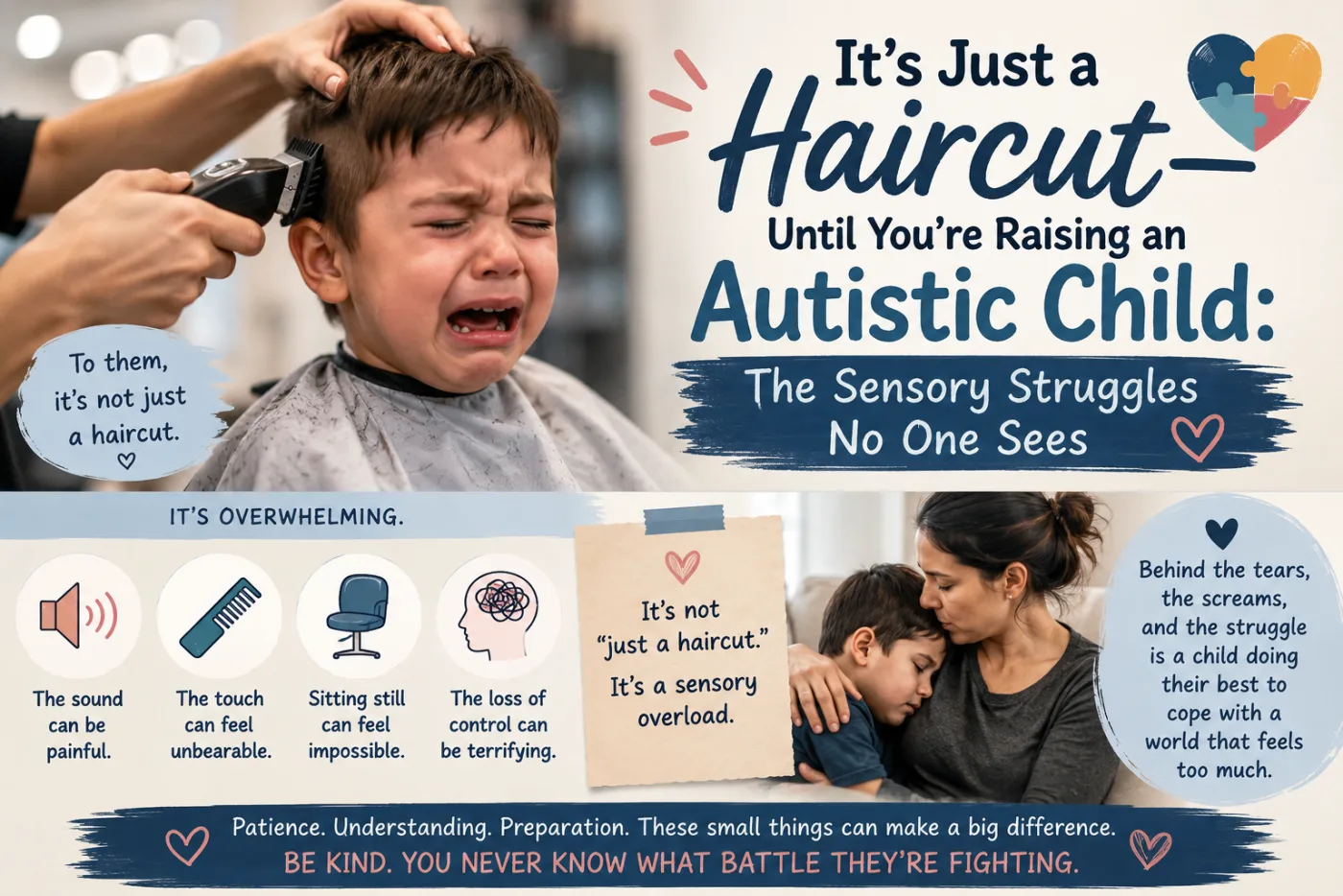
It is eleven at night and I am sitting on my bathroom floor with a pair of scissors, cutting my sleeping son’s hair one careful snip at a time.
This is the third night I’ve done this. We’re maybe halfway.
I used to be ashamed of it. Then I started talking to other autism moms and found out how many of us are doing this exact thing, on bathroom floors, at this exact hour, holding our breath every time the child shifts.
Before this, we tried it the normal way. I have stood in a salon parking lot, shaking, with a half-finished haircut and a child who was done — completely, non-negotiably done — before anyone got near the second side.
I got here because of something a stranger said to me that afternoon.
Quick Takeaways
- A haircut isn’t one sensation, it’s about eight at once — noise, vibration, hair on skin, a tight cape, a stranger’s hands, mirrors, smells, and being asked to sit still through all of it
- Meltdowns during haircuts are a nervous system response, not defiance, and no amount of discipline will change a sensory reaction
- Preparation over days or weeks works far better than any technique tried in the chair itself
- Most families land on a home routine, an accommodating stylist, or a sensory-friendly salon — the standard barbershop is often just the wrong environment
- A “good haircut” for our kids sometimes means uneven and finished, and that counts
The Sentence That Made Me Want to Disappear
“It’s just a haircut.”
A woman said it to me while my son was screaming in a barber’s chair, arching his back so hard the cape came loose, hair stuck to the tears on his face. She wasn’t being cruel. She genuinely thought she was helping me relax.
But I remember standing there thinking, you have no idea what you’re watching.
Because she saw a child making a fuss about something ordinary. I saw a little boy whose entire nervous system was screaming at him that he was in danger, and who had no words to tell anyone why.
What a Haircut Actually Feels Like
Here’s what I wish someone had explained to me early, because once I understood it, I stopped trying to fix the behavior and started fixing the environment.
A haircut is not one thing. It’s a stack of overwhelming sensory input happening at the same moment:
- The clipper noise. A high, unbroken buzz that sits in exactly the frequency range many autistic children find unbearable — and it’s held inches from the ear.
- The vibration. That buzz travels through the skull. You feel it in your teeth. Most of us tune it out; a lot of our kids can’t.
- Hair falling on skin. Thousands of tiny prickling points on the neck, the face, inside the collar. For a child with tactile sensitivity, this isn’t mildly annoying — it’s closer to how you’d feel about insects on your neck.
- The cape. Tight at the throat, restricting arms, made of a slick material that many kids hate touching.
- A stranger’s hands on the head and neck. Unpredictable touch, in one of the most vulnerable places on the body, from someone the child has no relationship with.
- The mirror. Constant visual movement, sometimes multiple reflections, in a room that’s already bright and busy.
- The smell. Products, chemicals, other people’s hair.
- Being asked to hold still. The one thing that helps regulate an overwhelmed body — movement — is exactly what everyone is asking the child not to do.
Eight overwhelming things at once, in a strange room, with no ability to say stop.
Now ask yourself honestly whether you’d sit calmly through that.
It’s Not Behavior. It’s a Nervous System.
This is the part that took me the longest to accept, and the part I’d most want another parent to hear.
When my son melted down in that chair, he was not being difficult. He wasn’t testing me. He wasn’t spoiled, and he hadn’t been “given in to” too many times — which is what a relative once suggested.
He was in genuine distress. His body had decided this was a threat, and once a nervous system reaches that point, reasoning is offline. You cannot negotiate with a fight-or-flight response. You cannot consequence it away. Every sticker chart in the world will not convince a body that the buzzing thing near its ear is safe.
Understanding this changed how I approached everything. I stopped asking how do I get him to tolerate this and started asking how do I make this less threatening. Those are completely different questions, and only one of them has an answer.
It’s the same shift that helped me most with safe foods instead of “picky eating” — once you see the sensory reason underneath, the behavior stops looking like a choice.
What Finally Worked for Us
None of this happened in one afternoon. It took months, and we still have hard days. But this is the approach that moved us from “impossible” to “manageable.”
Start long before the haircut
The work happens on ordinary days, not haircut day.
We left the clippers out on the living room floor, switched off, for about a week. He was allowed to ignore them, touch them, throw them, whatever. Then we turned them on across the room while he played, for a few seconds. Then closer. Then on his arm, then his shoulder, then the back of his neck — over many days, never pushing past the point where he tensed up.
This is desensitization, and it is slow on purpose. The moment you rush it, you’re back to square one, and you’ve also taught your child that showing discomfort doesn’t stop things. That lesson is expensive.
Make it predictable
Uncertainty is its own sensory load. We used the same visual sequence every time — a card for cape, a card for clippers, a card for finished, a card for what comes after. He could see the end from the beginning.
We also used a first/then: first haircut, then bath. Not as a bribe, but so the shape of the afternoon was never a surprise.
Cut the input down
Every sensation you can remove is one less thing stacked on the pile:
- Ear defenders for the noise. For us this was the single biggest change.
- A dry cut, no wash, no spray bottle.
- No cape. We do haircuts with his shirt off and go straight into a bath afterward, which solves the hair-on-skin problem entirely.
- No mirror, and no bright overhead light.
- Deep pressure first — a few minutes of firm squeezes or a weighted lap pad before we start, which helps his body settle before we add anything new.
- Something in the hands and mouth. A chewy, a fidget, a tablet. This is not the moment to worry about screen time.
Pick your moment
Never when hungry. Never when tired. Never straight after school, when the day’s sensory bucket is already full. For us, weekend mornings after breakfast are the only reliable window.
Let it be unfinished
This was the hardest one for me to accept, and the most important.
We stop when he’s done. Sometimes that means one side. Sometimes it means we finish the next day. A haircut completed over three sessions with a calm child is an enormous success. A haircut completed in one session with a child restrained and sobbing teaches him that this thing happens to him no matter what he does — and it makes next time worse, not better.
Uneven hair grows out. That association doesn’t.
If You’d Rather Not Do It Yourself
Plenty of parents can’t or don’t want to cut hair at home, and that’s completely reasonable.
Look for sensory-friendly salons. They’re becoming more common — appointment-only, quieter rooms, stylists with actual training in working with autistic children. Search your area for “sensory friendly haircut,” and check local autism parent groups on social media, which are usually a faster and more honest source than a Google listing.
Or train a regular stylist. Ours is a neighborhood barber who was willing to learn. What made the difference:
- The first appointment of the day, before the shop fills up
- No music, clippers already running when we walk in so there’s no startle
- We bring our own ear defenders and cape-free routine
- She talks to him, not about him, and she tells him before she touches him
- She’s fine with stopping partway through
Call ahead and ask directly whether they’ve cut an autistic child’s hair before. The answer, and how they respond to the question, tells you almost everything.
And yes — the sleep haircut is legitimate. Plenty of us have trimmed hair on a sleeping child. It isn’t a failure or a cheat. Sometimes it’s simply the kindest option available that week.
The Part That Still Gets Me
I want to be honest about something, because I think we don’t say it enough.
It isn’t only the haircut that’s hard. It’s the audience.
It’s the other parents watching. The stylist who sighs. The person in line who mutters something about discipline. The relative who says he’ll grow out of it. It’s walking out with a half-finished haircut and feeling every pair of eyes in the room.
I’ve gotten better at this, but I haven’t gotten immune to it. Most days I can hold onto the fact that these people are seeing ninety seconds of a life they know nothing about. Some days I still cry in the car.
If that’s you too, you’re not weak. The judgment really is one of the hardest parts, and it’s separate from — and often heavier than — the thing everyone thinks they’re watching.
What I’d Tell Myself Two Years Ago
That the goal was never a perfect haircut.
The goal was a child who learned that his discomfort would be listened to. That when his body said this is too much, someone would stop and help instead of holding him down. That the adults around him could be trusted with the things he couldn’t explain.
He still doesn’t love haircuts. He probably never will. But last month he sat through one, in a chair, with his ear defenders on and a chewy in his hand, and when it was over he looked at me and did his happy flap.
Nobody in that shop knew what they’d just watched. Two years of work, in a five-minute haircut.
I did. And that was enough.
Frequently Asked Questions
Why do autistic children hate haircuts so much?
Because a haircut delivers many overwhelming sensations at once — clipper noise and vibration, hair falling on sensitive skin, a tight cape, unfamiliar touch on the head and neck, bright lights, mirrors, and strong smells — while the child is asked to stay still. For a child with sensory processing differences, that combination can register as genuinely threatening rather than merely unpleasant.
How do I cut my autistic child’s hair without a meltdown?
Prepare over days or weeks rather than minutes: leave the clippers out, introduce the sound gradually from across the room, and work closer only as your child stays comfortable. On the day, remove as much sensory input as you can — ear defenders, no cape, no mirror, a dry cut — use a visual schedule so the sequence is predictable, and stop as soon as your child has had enough, even if the cut isn’t finished.
Is it okay to cut my child’s hair while they’re sleeping?
Many parents do, and it’s a reasonable option. It avoids distress entirely, though it usually only works for small trims and for children who sleep deeply. Most families use it alongside gradual daytime desensitization rather than instead of it.
What is a sensory-friendly haircut?
An appointment adapted for sensory needs — typically a quiet room, no music, low lighting, a stylist trained to work with autistic children, extra time, permission to take breaks, and flexibility about capes, mirrors, and position. Some salons advertise this directly; many regular stylists will accommodate it if you ask.
Will my child ever get used to haircuts?
Many children do become more tolerant over time, especially with gradual, respectful exposure that never overrides their distress signals. Progress is usually slow and uneven, and “tolerating it with supports” is a realistic and completely valid outcome — full comfort isn’t the only success.
Is a haircut meltdown a tantrum?
No. A tantrum is goal-directed behavior a child can stop when the goal changes. A sensory meltdown is an involuntary response to overwhelm, and the child cannot stop it on request. The two look similar from outside and need completely different responses — understanding what’s underneath the crying is often the first step.
Conclusion
If you’re heading into a haircut this week with your stomach already in knots, I hope you take one thing from this: you are not doing it wrong, and your child is not giving you a hard time. Your child is having a hard time, with a body that experiences the world at a volume most people never have to think about.
Go slow. Take away everything you can. Stop when they need to stop. Let the back be uneven.
And the next time someone tells you it’s just a haircut, you’ll know exactly how much they’re not seeing — and you won’t need them to understand, because you already do. If today was one of those days where everything felt too heavy, you’re genuinely not the only one.
Sources:
- Centers for Disease Control and Prevention (CDC) — Signs and Symptoms of Autism Spectrum Disorder
- American Academy of Pediatrics (AAP) — Sensory processing differences and family guidance
- STAR Institute for Sensory Processing — Sensory over-responsivity in children
- Autism Speaks — Personal care, grooming, and sensory-friendly community resources
Comments