My Child's Autism Doesn't Sleep—And Some Nights, Neither Do I
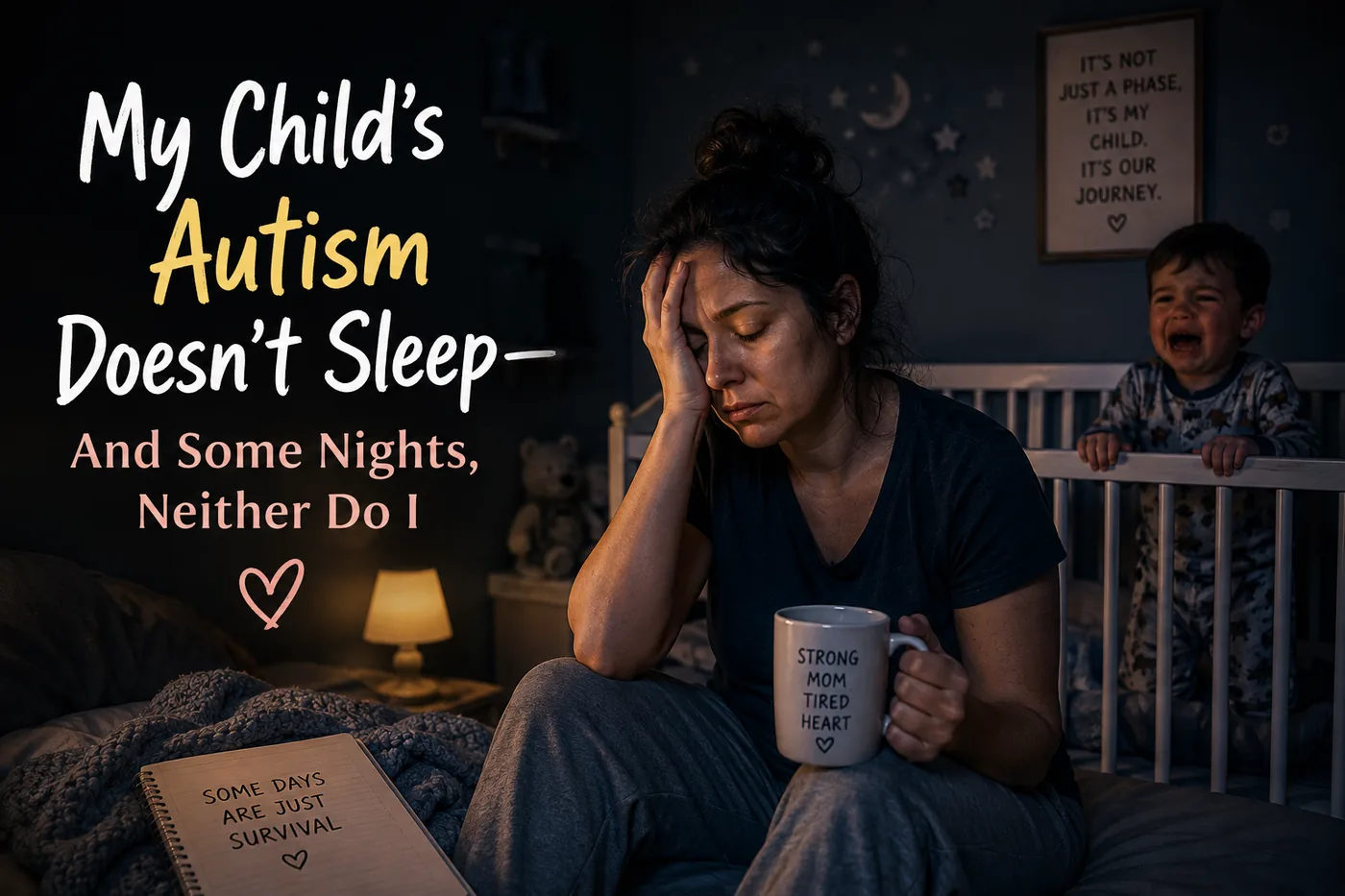
It is 2:14 AM and my son is standing at the end of my bed.
He isn’t upset. He isn’t sick. He isn’t asking for anything. He is just awake — fully, brightly awake, the way most people are at eleven in the morning — and he has come to find me because I am the person he finds.
I already know how this goes. He will be up for somewhere between forty minutes and four hours. There is no negotiating it, no sleep training method that touches it, no version of tonight where I lie back down and drift off knowing he’s settled. So I do what I always do. I pull back the blanket, I say “okay, buddy,” and I get up.
This is the part of autism parenting almost nobody warns you about. Not the diagnosis appointment. Not the therapy schedule. The nights.
Nobody Told Me Sleep Would Be the Hardest Part
When we got the diagnosis, I was handed a folder. It had information about speech therapy, occupational therapy, early intervention, and a photocopied page about sensory processing. Somewhere in there was a single line about “possible sleep difficulties.”
A single line. For the thing that would go on to reshape our entire family’s life.
Because sleep isn’t one problem. Sleep is the foundation everything else sits on. When my child doesn’t sleep, his sensory threshold drops through the floor the next day. Transitions get harder. Meltdowns come faster and last longer. His words — the ones we worked years for — thin out and disappear. And I, running on three broken hours, have less patience exactly on the day he needs the most of it.
That’s the loop. Bad night, hard day, harder night. It doesn’t feel like a symptom. It feels like the weather.
If Your Autistic Child Doesn’t Sleep, You Are Not an Outlier
For a long time I thought this was something I was doing wrong. I read the sleep training books. I did the routine. I did it perfectly, the way you do when you’re quietly certain the problem must be you.
Then I found the research, and something in my chest loosened.
Sleep problems are one of the most common co-occurring conditions in autism. Studies consistently find that somewhere between about half and 80% of autistic children have significant trouble sleeping — falling asleep, staying asleep, or both — compared with roughly a quarter of non-autistic children. Autism Speaks, the American Academy of Pediatrics, and a large body of sleep research all point in the same direction.
Half to eighty percent. That is not a parenting failure. That is a feature of how a lot of autistic nervous systems are wired.
I want you to sit with that number for a second, especially if you have been blaming yourself. The reason the standard sleep advice didn’t work is that the standard sleep advice was not written for your child.
Why Sleep Is So Hard for Autistic Children
Understanding the why didn’t make my nights shorter, but it did make them less lonely. Here is what’s actually going on under the surface, as it was eventually explained to us.
Melatonin works differently. Melatonin is the hormone that tells the body night has arrived. Research has found differences in how melatonin is produced and regulated in many autistic people — sometimes less of it, sometimes released at the wrong time of night. The internal signal that says it’s dark, wind down can arrive late, or faintly, or not at all.
The sensory system doesn’t switch off. My son can hear the refrigerator compressor from his bedroom. He can feel the seam of a sock through the blanket. Falling asleep requires a brain to stop cataloguing input, and a sensory system on high alert simply doesn’t stop.
Anxiety runs at night. Days are full of demands and structure. Night is empty, and empty is where worry expands. A lot of autistic kids — including verbal ones who can’t yet explain it — are lying there anxious rather than tired.
Bodies get in the way. GI problems, reflux, constipation, and eczema are all more common in autistic children, and all of them are worse lying down in the dark. Some medications, particularly stimulants prescribed for co-occurring ADHD, also affect sleep onset.
Routine is regulation. For a child who relies on predictability to feel safe, one changed variable — a different bath time, a visitor, a new pillowcase — can undo the whole sequence.
None of these are behavioral problems. That distinction matters, because behavioral problems get behavioral solutions, and this needed something else entirely.
The 2 AM Loneliness Nobody Photographs
There is a particular kind of tired that belongs to autism parents at 2 AM.
It isn’t newborn tired. Newborn tired has an end date, and it comes with casseroles and visitors and everyone acknowledging that you’re in the trenches. This tired has no end date and no audience. The rest of the world is asleep. Your partner, if you have one, is asleep — or awake in the next room, doing their own shift. The group chat is quiet. You are the only lit window on the street.
I have made three separate life decisions at 2 AM that I do not remember making. I have cried in a hallway with a hand over my mouth so the sound wouldn’t carry. I have sat on the floor outside his room at 3:40 AM doing the arithmetic — if he goes down now, I get two hours — the way other people count money.
If you are reading this at an hour you shouldn’t be awake: I see you. This is real, it is heavy, and being flattened by it does not mean you love your child any less. It means you have been awake for four years. That’s all it means. I’ve written more about the isolation that comes with autism parenting, because the nights are only one part of it.
What Actually Helped in Our House
I’m going to be careful here, because the internet is full of people promising that one product fixed their child’s sleep. Nothing fixed ours. Some things genuinely made it better, and I’ll tell you which, honestly — including the famous one that didn’t do what I expected.
Same order, every single night. Not the same time — the same sequence. Bath, pyjamas, two books, song, lights down, door half open. He can predict every step. Predictability is what lets his body start powering down before I ask it to. It took about six weeks before we saw any difference at all, which is longer than any sleep book prepares you for.
Light discipline, all evening, not just at bedtime. Screens off ninety minutes before bed, and every light in the house dropped to warm and low after dinner. Bright white light suppresses melatonin, and when your child may already be short on it, you can’t afford to be casual about that.
Cold room, heavy blanket, deep pressure. Here’s the honest bit: a well-known randomized controlled trial of weighted blankets for autistic children with severe sleep problems found they did not objectively improve how long the children slept. But the children and families overwhelmingly preferred them anyway. That matched our experience exactly. The blanket didn’t add hours. It made him calmer going in, and calmer is worth something even if the sleep tracker disagrees.
Deep pressure before bed, not just during. Firm back rubs, a squeeze under a cushion, ten minutes of heavy work like pushing a laundry basket. Occupational therapists call it proprioceptive input. It settles his body in a way that no amount of quiet does.
Door alarms — for me, not for him. This one changed my life more than anything on the list. Nighttime wandering is a serious safety issue for autistic children, and a big part of why I never slept deeply was that I was functioning as a human alarm system. A cheap chime on the front door meant I could finally sleep lightly instead of not at all.
Naming the thing that’s coming. “After the song, I turn the light off, and then it’s sleep time.” Out loud, every night, the same words. Removing surprise removes half the resistance.
The Conversation to Have With Your Doctor
Please have it. I waited far too long, because I had absorbed the idea that this was just our life now.
Bring a sleep diary — two weeks of when he went down, when he woke, how long he was up. Data gets taken more seriously than “he doesn’t sleep,” and it also reveals patterns you can’t see from inside the exhaustion.
Ask specifically about ruling out medical causes: reflux, constipation, allergies, sleep apnea (enlarged tonsils and adenoids are a common and very fixable culprit), and whether any current medication could be affecting sleep onset.
And ask about melatonin rather than starting it yourself. There’s reasonable evidence for short-term use in autistic children, and it’s widely recommended — but dose and timing matter enormously, the supplement market is poorly regulated, and it is not a substitute for figuring out why the sleep isn’t happening. This is a pediatrician conversation, not a health-food-aisle decision. If your doctor waves it away, ask for a referral to a pediatric sleep specialist. They exist, and they are worth the wait.
What I’ve Stopped Doing
I’ve stopped trying to sleep-train him out of a neurological difference. That was never going to work, and every failed attempt cost me confidence I couldn’t spare. Standard sleep training methods assume a nervous system that settles when left alone. His doesn’t.
I’ve stopped treating a 2 AM wake-up as a failure of the day before. Some nights are just going to be bad for reasons neither of us can identify, the same way some crying has no findable cause.
I’ve stopped apologizing for sleeping when he sleeps, at whatever ridiculous hour that lands. Weekend naps are not indulgence. They are how I stay a functioning parent by Wednesday.
And I’ve stopped comparing our nights to anyone else’s. A mother at school told me her four-year-old “sleeps twelve hours straight, we’re so lucky,” and she meant it kindly, and I went home and felt terrible for a day. That comparison had nothing useful in it. I let it go.
Some Nights I Sleep. That Counts Too.
I don’t want to end this in the dark, because that isn’t the whole truth either.
Last Tuesday he slept from 8:15 PM until 6:40 AM without waking once. I know the exact times because I checked the clock at 3 AM out of pure habit, saw a quiet hallway, and lay there almost too surprised to go back to sleep.
We get those now. Not often. More than we used to. The routine we built over years is doing something, slowly, in a direction I couldn’t see while I was inside the worst of it. That’s most of what progress has looked like in our whole 24-hour day — measured in inches, noticed months later.
If you’re in the four-broken-hours part right now, I’m not going to tell you it ends. I don’t know that. But it changes. Ours changed. And on the nights it doesn’t, you’ll get up anyway, say “okay, buddy,” and get through it — which is not a small thing, even though nobody will ever see you do it.
Frequently Asked Questions
Why won’t my autistic child sleep?
Sleep difficulties are extremely common in autism — research consistently finds that roughly half to 80% of autistic children have significant sleep problems, compared with about a quarter of non-autistic children. The usual causes are differences in melatonin production and timing, a sensory system that doesn’t switch off, nighttime anxiety, co-occurring medical issues like reflux or sleep apnea, and disruptions to routine. It is a neurological and physiological difference, not a discipline problem.
Is melatonin safe for an autistic child?
Melatonin is widely used and there is reasonable evidence supporting short-term use in autistic children with sleep-onset problems — but dose and timing matter a great deal, supplements are inconsistently regulated, and it shouldn’t be started without medical guidance. Talk to your pediatrician first, and treat it as one part of a plan rather than the whole plan.
Do weighted blankets help autistic children sleep?
Not as much as the marketing suggests. A well-known randomized controlled trial in autistic children with severe sleep problems found weighted blankets did not objectively increase sleep duration — though the children and families strongly preferred using them. Many parents, including me, find they help a child feel calmer settling down even when they don’t add hours. Always follow the manufacturer’s weight and age guidance.
How much sleep does an autistic child actually need?
The same as any child of the same age — roughly 10 to 13 hours for preschoolers and 9 to 12 hours for school-age children, per American Academy of Pediatrics guidance. The difference is that autistic children often need considerably more support to get there, and frequently fall short of it.
Why does my autistic child wake up in the middle of the night and stay awake?
Night waking with prolonged alertness is one of the most commonly reported sleep patterns in autism. It’s often linked to melatonin timing, a body that struggles to return to sleep once alert, sensory sensitivity to small noises or light, or discomfort from an untreated medical issue. A two-week sleep diary is the most useful thing you can bring to a doctor about it.
Is nighttime wandering a real risk?
Yes, and it’s worth taking seriously. Elopement — leaving a safe space unsupervised — is a well-documented safety concern in autism, and night is a high-risk window. Door and window alarms, secure locks placed out of reach, and letting neighbors know are practical steps that also let parents sleep more deeply.
How do autism parents cope with chronic sleep deprivation?
Honestly, imperfectly. What helps: splitting nights with a partner so one person gets an unbroken stretch, sleeping when your child sleeps without guilt, getting medical causes ruled out rather than assuming it’s permanent, and telling at least one person the truth about how tired you are. Chronic sleep deprivation is a health issue for you as well as a hardship — it deserves treatment, not endurance.
Conclusion: The Nights Are Long, and You Are Not Failing Them
If your autistic child doesn’t sleep, you are not doing autism parenting wrong. You are parenting a nervous system that genuinely works differently after dark, and you are doing it with almost none of the sleep a person needs to do anything well.
Build the routine. Get the medical causes ruled out. Take the safety measures so you can sleep lighter. Ask for the referral. And then forgive yourself for the nights when none of it works, because those nights are going to happen anyway and they are not a verdict on you.
It is 2:14 AM somewhere, and someone else is standing in a dark hallway right now, doing exactly what you’re doing. You’re not the only lit window on the street. It just looks that way from inside.
Comments