Speech Therapy for an Autistic Child: What I Wish I'd Known Before We Started
Before we started speech therapy, my son didn’t look at me. He walked with his eyes tipped toward the ceiling, as if whatever was happening above him was more interesting than any of the people in the room. He ran, and ran, and ran. He moved between activities in a world that seemed to have its own doors, and he rarely came back through them to find me. He didn’t bring me things. He didn’t point. He didn’t use words to tell me what he wanted, and he didn’t seem to need to. I would watch him from across the room and quietly ask myself the question I was too frightened to say out loud: what is going on with my child?
At that point I genuinely didn’t know. I had never searched “early signs of autism” at midnight. I wasn’t reading developmental research. I didn’t have any of the vocabulary I use every day now. I was just a mother watching her child and feeling, in a place underneath language, that something was different. If that is exactly where you are sitting today, I want to give you the version of this information I didn’t have — written the way I wish someone had explained it to me, before the first appointment instead of two years into it.
Quick Takeaways
- Speech therapy for an autistic child is about communication, not just spoken words — gestures, pointing, requesting, and AAC all count as real goals
- A speech or language delay does not automatically mean autism, and you don’t need a diagnosis to ask for a speech-language evaluation
- Research reviewed by ASHA has found AAC does not stop a child from learning to talk — in some studies speech production actually increased
- Progress often shows up as a sound, a point, or a reach long before it shows up as a word, and those are the milestones that matter first
- The most useful question isn’t “when will my child talk?” — it’s “how can we help my child communicate today?”
The Speech Evaluation I Still Remember in Detail
When we finally sat down for the evaluation, I felt about four things at once. I wanted someone to tell me everything was fine. I also think a quieter part of me already knew it wasn’t, and had known for a while.
The evaluation itself was less scary than I’d built it up to be. The speech-language pathologist watched how my son communicated, how he responded to his name and to instructions, how he played, what sounds he made, and what he did when he wanted something he couldn’t reach. She wasn’t testing him the way a school tests a child. She was collecting a picture of how he was already communicating — because he was communicating, just not in the ways I had been taught to look for.
Then came the words I didn’t have definitions for yet. Receptive language. Expressive language. Social communication. Joint attention. Speech delay. Developmental concerns. I sat there nodding, trying to hold all of it, while the only sentence running through my head was: what does any of this mean for my child?
I didn’t understand yet that some children communicate very differently from most children, and that difference isn’t the same as absence. I didn’t understand that a child can have an enormous amount to say and no available way to say it. And I had no idea how central speech therapy would become to our week, our budget, and honestly, my own education as a parent.
I Thought Speech Therapy Was Just About Talking
This is the single biggest thing I’d go back and tell myself. When I heard “speech therapy,” I pictured a therapist teaching my son to pronounce words. I thought the whole point was to answer one question: when will he talk?
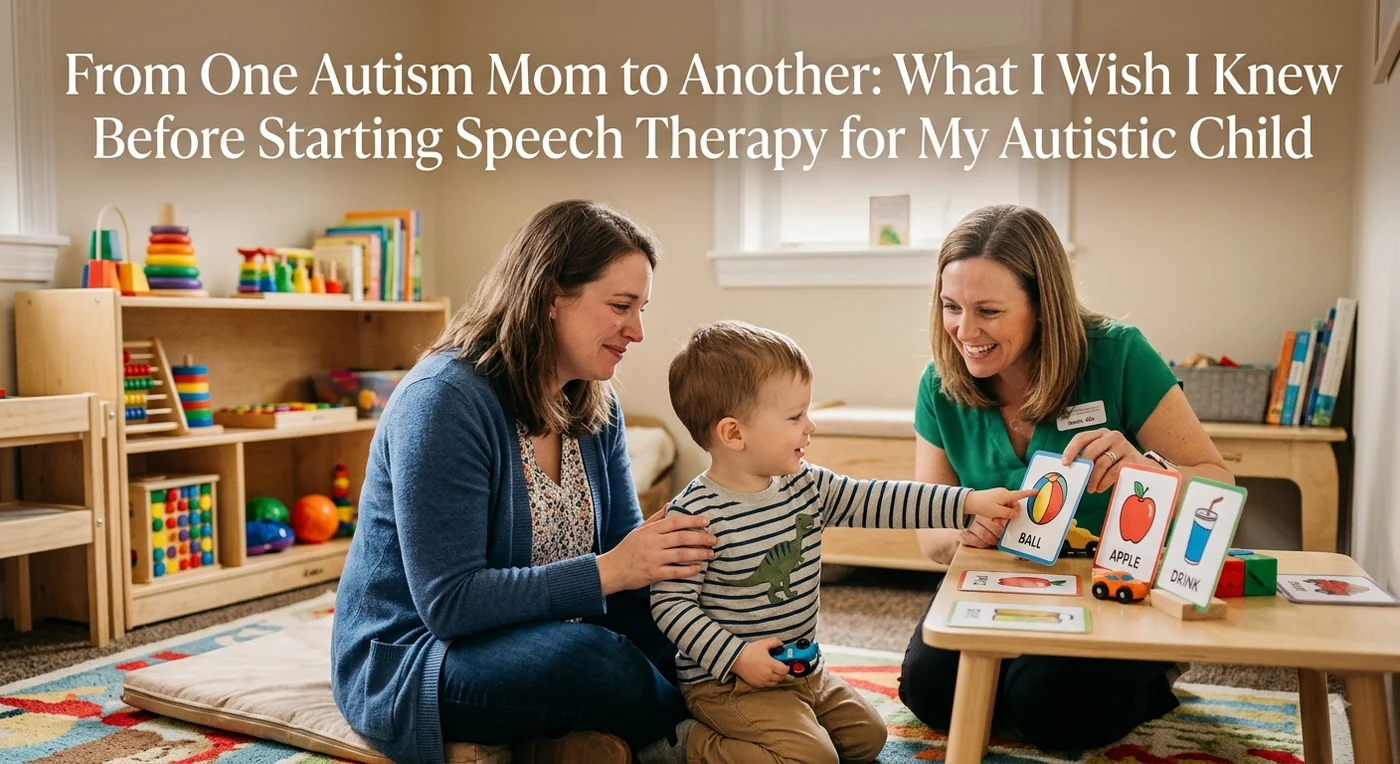
Speech-language therapy is much broader than that. A speech-language pathologist may work on understanding language and using language, on gestures, on social communication, on following directions, on asking for help, on taking turns, on playing alongside and then with other children, and on making speech clearer when speech is present but hard to understand. For children who use few or no spoken words, an SLP can also help a family explore other ways to communicate, including augmentative and alternative communication (AAC).
Once I understood that, the whole thing reframed. Communication comes first. Talking is one way to communicate — an important one, but not the only one. My son didn’t need to become a different child. He needed a reliable way to tell me what was happening inside him.
A Speech Delay Doesn’t Automatically Mean Autism
I want to say this clearly, because I know some of you are reading this in a panic after one worrying Google search. A speech or language delay on its own does not mean your child is autistic. Children can be late to talk for many different reasons, and a speech-language evaluation exists precisely to sort out which parts of communication need support.
At the same time, communication differences can be one part of autism. That’s exactly why an evaluation is worth doing rather than waiting out. If your child isn’t talking as expected, isn’t using many words, doesn’t seem to understand what you’re saying, responds inconsistently to their name, or is struggling to make their needs known, you don’t have to arrive at the pediatrician’s office with a theory. You just have to describe what you’re seeing and ask for a developmental screening and a speech-language evaluation.
You are not required to figure out the diagnosis yourself. You only have to notice, and ask. If you’re trying to untangle the two right now, autism vs. speech delay in toddlers walks through the specific differences clinicians look at, and what to do when your toddler isn’t talking at 2 covers the first practical steps.
What Speech Therapy Actually Works On
Every child is different, so goals should be individualized to your child rather than pulled off a generic list. But depending on what your child needs, speech-language therapy may target developing speech sounds and spoken words, understanding language, expressing wants and needs, following directions, pointing and gesturing, asking for help, answering questions, taking turns, social communication, playing and interacting with others, speech clarity, vocabulary, and communication systems such as AAC.
Written on an evaluation report, those look like bureaucratic bullet points. In a house, they look completely different. They look like a child who used to sob on the kitchen floor because he couldn’t tell you he was hungry, and who can now walk to the fridge and point. They look like a child who had no way to ask for help and now has a word, a sign, a picture card, or a device that does it for him. They look like a child who finally has a way to show you what he wants instead of melting down because you guessed wrong for the fourth time.
That is communication, and it is enormous progress even when it contains no spoken words at all.
What About a Child Who Is Nonverbal?
I worried about this constantly, so I’ll be direct about it. When your child isn’t talking, it is genuinely painful to lie awake wondering whether they will ever be able to tell you what hurts, what they’re afraid of, what they love, or what they’re thinking about all day.
But not using speech is not the same as having nothing to say. Children communicate through gestures, facial expressions, body movement, sounds, pictures, signs, and AAC devices. AAC stands for augmentative and alternative communication, and it covers everything from a laminated picture board to a speech-generating app on a tablet.
Here is the part I most want parents to hear, because fear on this point costs families months: you do not have to choose between AAC and speech. Research reviewed by the American Speech-Language-Hearing Association has found that AAC interventions do not appear to impede speech development, and some studies reported gains in speech production — though results vary from child to child and expectations should stay realistic. The purpose of AAC is not to give up on your child’s voice. It is to give your child a voice now, while everything else keeps developing.
If your child is older and still waiting on that first meaningful word, my son was four and not talking yet is the piece I wrote from the middle of that particular kind of waiting.
Speech Therapy Is Not a Race
You will watch another child start talking. You will hear that someone’s daughter picked up ten new words in a month. You will meet a family who started therapy after you did and whose child is suddenly stringing sentences together. And you will go home, close the bathroom door, and cry. I have done exactly that.
Our children are not running the same course on the same clock. One child starts with sounds. Another starts with gestures. Another learns to point, which is a bigger developmental deal than it sounds. Another begins with pictures, another with a device, and another says a word you have been waiting eleven months to hear on a random Tuesday afternoon with nobody else in the room to witness it.
Sometimes progress is so small that no one else in your life notices it. You notice it. That counts.
The Small Things Became the Whole Point
Before this journey, I would have looked at some of these moments and thought, well, that’s minor. I don’t think that anymore. A new sound is big. Turning toward you when you say their name is big. Reaching for you is big. Pointing is big. Attempting to imitate a sound is big. Bringing you an object because they want you to do something with it is big. Finding any new way to ask for something is big.
When you’re raising an autistic child, you learn to celebrate progress that most people will never be able to see. They don’t have to see it. You do. If the loneliness of that is hitting you right now, why autism parents feel so isolated says the rest of what I’d want to say about it.
Speech Therapy Reduces Frustration, Not Just Silence
Try to actually sit inside this for a second. You want something. You can’t explain it. The person in front of you doesn’t understand. You try again, harder. They still don’t understand. Now imagine going through that as a small child who doesn’t yet have any tool to explain what’s happening — not to describe the want, and not to describe the frustration about the want.
An enormous amount of what gets labeled “behavior” is communication that has nowhere to go. Giving a child dependable ways to communicate gives them more independence and more say over their own day: what they eat, what they play with, when they need a break, when something hurts. That reframe is what finally changed my question from “will my child talk?” to “how can I help my child communicate?” The second question had answers I could act on that same week.
Questions I Wish I’d Asked the Speech Therapist
You are not being difficult by asking questions. You’re the parent, you’re the one implementing this at home, and you deserve to understand the plan. If I could redo our first months, I’d have asked:
What are my child’s communication strengths, not just delays? What are we targeting first, and why that? Is the main difficulty with understanding language, expressing language, producing speech sounds, or social communication? What should progress look like over the next three months, and what should I watch for? Would AAC be appropriate for my child, and if not yet, what would make it appropriate? How do I fold this into meals, bath time, and the car instead of adding another block to our schedule? And what should I do in the moment when my child is melting down specifically because they can’t communicate?
Write them on your phone before the session. I promise the therapist would rather answer them than have you guessing for six months.
You Don’t Have to Turn Your Home Into a Clinic
This was the relief I needed most, because I was exhausted and quietly convinced I was failing at homework I’d been assigned by nobody. Opportunities to communicate are already everywhere in your day. You can narrate breakfast. You can name clothing while getting dressed. You can pause in the middle of a favorite song or a tickle game and wait — that pause is a genuine strategy, not laziness. You can offer two choices instead of just handing something over. You can read the same repetitive book for the nine hundredth time and leave the last word of the line hanging. You can follow whatever your child is already interested in instead of redirecting them to what you think they should be interested in.
Research on parent-mediated interventions has found improvements in aspects of spoken language and social communication, although outcomes vary between children. Your child’s SLP can show you which specific strategies fit your child. But your job was never to become a second therapist. Your job is to connect with your child and keep leaving doors open for communication to walk through.
What If My Child Doesn’t Talk Right Away?
I’m not going to end this with a promise I can’t make, because I know how it feels to be handed false comfort. Speech therapy is not a switch. There is no single timeline that applies to every autistic child.
Some children make substantial gains in spoken language. Others continue communicating primarily through other methods. Many use a mix — some speech, some signs, some pictures, a device for longer or harder messages. Studies of language-focused interventions in young autistic children show overall benefit, but the effects are variable and individual outcomes genuinely differ.
So instead of measuring the whole thing against “when will my child talk,” I learned to ask “how can we help my child communicate more effectively this month?” That question has never once had no answer.
If You’re Reading This in a Waiting Room
Maybe your child’s first evaluation is in twenty minutes. Maybe you’re hoping someone comes out and tells you everything is fine. Maybe you’re bracing for the opposite. Maybe you don’t even know what you’re supposed to ask.
You don’t have to know everything today. I didn’t. I didn’t know the word autism in any meaningful way. I didn’t understand what any of the developmental terms meant. I had no idea what our life would look like. I was just a mother trying to understand her child — and looking back, that turned out to be enough to start with. I didn’t need the answers before asking for help. I only needed to take the first step. If you’ve just received a diagnosis and everything still feels unreal, what I wish I’d known after the autism diagnosis is where I’d send you next.
To the Mom Who Is Where I Was
If your child isn’t talking yet, I know exactly how heavy that is to carry around all day while acting normal. You will compare. You will wonder whether you waited too long. You will blame yourself for things that were never yours to cause. You will cry where nobody can see you, and you will lie awake constructing futures you have no way to predict.
Please be gentler with yourself than that. You didn’t know this yesterday. You’re learning it today. Tomorrow you’ll know a little more. That’s all parenting has ever been — it just has a steeper learning curve when your child is autistic. Find people who listen. Ask the questions. Work with qualified professionals. Learn how communication actually works. Celebrate the attempts, not just the successes. And keep seeing the child in front of you rather than the diagnosis or the delay.
My son was never “a child who wasn’t talking.” He was my child. He had preferences and opinions and a sense of humor. He had a whole way of experiencing the world that I had to slow down and learn. The work was never getting him to be someone else. It was meeting him where he already was.
Frequently Asked Questions
When should I start speech therapy if my child has a speech delay?
If you’re concerned about your child’s speech or language, bring it to your pediatrician and ask for a speech-language evaluation. You do not need an autism diagnosis first, and you don’t need to wait to see whether your child grows out of it. Early support is generally easier to start than to catch up on.
Does every child with a speech delay have autism?
No. A speech or language delay does not automatically mean a child is autistic. Children can have communication difficulties for many different reasons, including hearing issues, expressive language disorder, or simply a late-talking profile. A qualified professional can evaluate your child’s individual developmental and communication needs.
Can speech therapy help an autistic child who doesn’t talk?
Yes. Speech-language therapy supports communication in autistic children who use few or no spoken words. Depending on the child, goals may include sounds, gestures, pointing, understanding language, requesting, social communication, and AAC. Progress is measured in communication, not only in speech.
Can AAC stop my child from learning to speak?
Current evidence does not support that fear. Research reviewed by ASHA found that AAC interventions did not impede speech production, and some studies reported increases in speech, although individual outcomes vary. AAC gives a child a way to communicate now rather than replacing the possibility of speech later.
What does a speech therapist do for an autistic child?
An SLP may work on receptive and expressive language, speech sounds and clarity, social communication, gestures, requesting, following directions, conversation, play skills, and alternative communication methods such as PECS or a speech-generating device. Goals should be based on your child’s specific strengths and needs, not a standard template.
What can parents do at home to support speech and communication?
Build communication into routines you already have — meals, dressing, bath, books, car rides, and play. Offer choices, pause and wait for a response, model single words or signs, and follow your child’s interests. Ask your SLP which specific strategies suit your child rather than trying every technique you read online.
How long does speech therapy take to work?
There’s no single timeline. Progress depends on your child’s communication profile, developmental needs, the approach used, consistency, and many other factors. Some children change noticeably within a few months; for others, progress is gradual and shows up first in non-spoken communication.
What if my child isn’t making progress in speech therapy?
Raise it directly with the SLP and ask what they’re seeing. Your child may need different goals, a different approach, further evaluation, or a communication method that hasn’t been tried yet. A lack of spoken words is not evidence that your child lacks communication potential.
Is speech therapy only for children who can’t talk?
No. Speech-language therapy also helps children who do speak but struggle with pronunciation, understanding language, putting thoughts into words, conversation, or the social side of communication — all of which are common areas of support for autistic children.
What’s the most important thing for a parent to remember?
Don’t measure your child’s worth by their word count. Words matter, communication matters more, and connection matters most. Sometimes the biggest step forward in a month is a moment only a parent would recognize — and it still counts.
Conclusion
When we started speech therapy, I was focused on words. I wanted to hear him call me. I wanted to know what he was thinking about. I wanted the ordinary conversations that other parents seemed to get without ever noticing they’d been given something.
What I learned instead is bigger than that. Communication is about connection, about being understood, about having choices, about being able to say more even when “more” isn’t spoken out loud. If you’re at the beginning of this, please don’t measure your child’s entire future by what they can do this week. Today is just today. Keep helping, keep learning, keep advocating, and keep celebrating the small wins that nobody else claps for.
Your child’s voice matters — whether it arrives as speech, gestures, pictures, signs, a device, or some combination nobody has invented a tidy name for yet. And if your school years are coming up next, what an IEP meeting really feels like is the one I’d read before that first meeting.
From one autism mom to another: you are not alone.
Sources:
- American Speech-Language-Hearing Association (ASHA) — Autism Spectrum Disorder practice portal; AAC and speech production research review
- American Speech-Language-Hearing Association (ASHA) — Late Language Emergence practice portal
- Centers for Disease Control and Prevention (CDC) — Developmental milestones and “Learn the Signs. Act Early.” screening guidance
- American Academy of Pediatrics (AAP) — Developmental surveillance and screening recommendations
- Research syntheses on parent-mediated communication interventions in young autistic children
This article shares one parent’s experience and general information. It isn’t medical advice — talk with your pediatrician or a licensed speech-language pathologist about your own child.
Comments