
INTRODUCTION A Positive Guide to Every Stage of Childhood Development
Your Child’s Growth Journey begins the moment they are born and continues through every age and milestone. Understanding Your Child’s Growth Journey helps parents support emotional, cognitive, and physical development in healthy, natural ways. Each stage of Your Child’s Growth Journey brings new skills, challenges, and learning opportunities. This guide explains these stages clearly so parents can support growth with confidence and knowledge.
Table of Contents
Understanding Your Child’s Growth Journey
Children grow in four important areas: physical development, emotional development, social skills, and cognitive understanding. When parents understand these areas, they can support each stage of Your Child’s Growth Journey with patience, guidance, and consistency. Childhood growth is not about perfection—it’s about progress.
Ages 0–3: The Beginning of Your Child’s Growth Journey
The early years are full of sensory exploration, bonding, and emotional foundation. During this part of Your Child’s Growth Journey, babies learn through touching, holding, hearing, and observing.
What happens in this stage:
- Rapid brain development
- Recognition of parents and caregivers
- First emotional attachments
- Early communication through sound and expression
How parents can support:
- Talk, sing, and read daily
- Respond to cues with warmth
- Offer safe sensory toys
- Maintain predictable routines
Helpful educational tool (natural link):
Soft Sensory Books → https://amzn.to/4h0UkB4
Ages 3–6: Imagination and Learning Take Off
This stage of Your Child’s Growth Journey is built on curiosity, creativity, and emotional expression. Children begin to understand feelings, ask questions, and explore through pretend play.
What happens in this stage:
- Growing vocabulary
- Understanding simple logic
- Development of empathy
- Strong imaginative play
How parents can support:
- Encourage storytelling
- Allow pretend play
- Name emotions and talk about feelings
- Offer simple problem-solving activities
Helpful educational tool (natural link):
Pretend Play Kitchen → https://amzn.to/3CM2Kjek
Ages 6–9: Skill-Building and Confidence
This part of Your Child’s Growth Journey is marked by increasing confidence and intellectual growth. Children begin reading more fluently, understanding rules, and enjoying teamwork.
What happens in this stage:
- Stronger memory and logic
- Interest in group play and teamwork
- Developing independence
- Expanding academic skills
How parents can support:
- Read daily and discuss stories
- Encourage STEM activities
- Praise effort over perfection
- Allow kids to take small responsibilities
Helpful educational tool (natural link):
STEM Starter Kit → https://amzn.to/3CYjJ6a
Ages 10–14: Emotional Growth and Independence
This is one of the most important stages of Your Child’s Growth Journey, where emotions deepen, identities form, and independence grows. Children begin to understand themselves better and seek autonomy.
What happens in this stage:
- Advanced reasoning
- Big emotional changes
- Stronger friendships
- Increased desire for independence
How parents can support:
- Communicate gently and openly
- Encourage hobbies like coding, journaling, or sports
- Listen without judgment
- Guide decision-making with patience
Helpful educational tool (natural link):
Coding Robot Kit → https://amzn.to/4hxV5HG
Everyday Moments Matter in Your Child’s Growth Journey
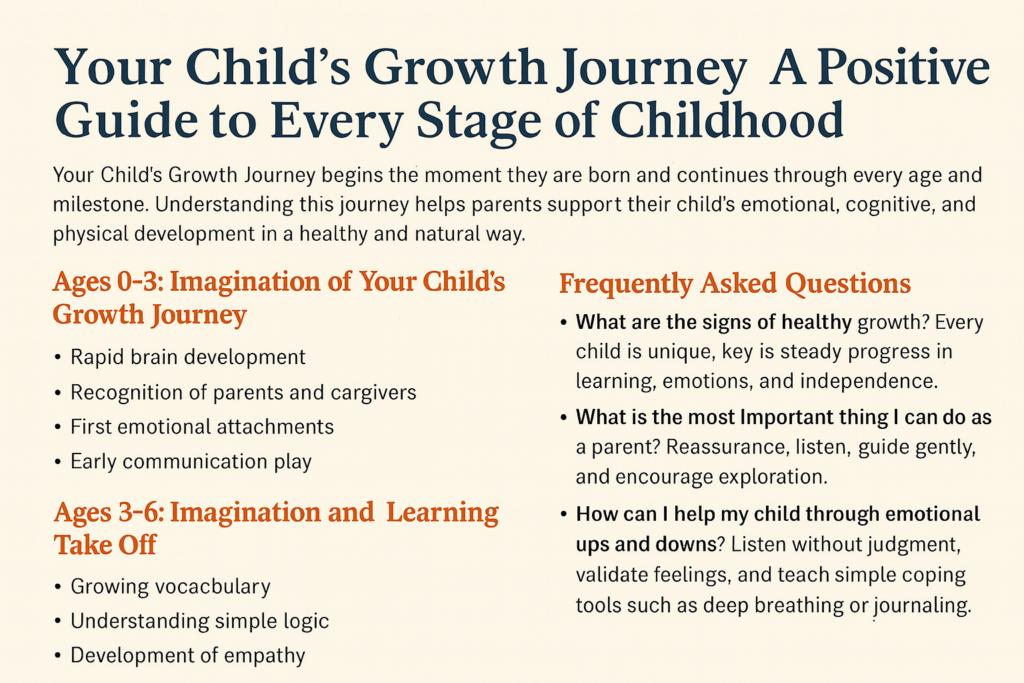
One of the most natural parts of Your Child’s Growth Journey is how much learning happens during normal daily activities. Cooking teaches math and responsibility. Reading strengthens imagination. Play teaches cooperation, patience, and problem-solving.
Parents support growth by turning everyday life into opportunities to learn, connect, and explore.
Emotional Development Throughout the Journey
Emotional intelligence is essential in Your Child’s Growth Journey. Children must learn how to name their feelings, express themselves, and handle challenges. Parents help by staying calm, listening closely, offering reassurance, and modeling emotional control.
Building Life Skills Step by Step
As Your Child’s Growth Journey progresses, life skills develop naturally:
- Young children learn routines and sharing
- School-aged kids learn responsibility
- Older kids learn decision-making and independence
These skills shape confidence and future success.
Final Thoughts
Your Child’s Growth Journey is unique, meaningful, and constantly changing. With patience, understanding, and gentle guidance, parents can support their child at every stage. You don’t need to be perfect—just present. Each moment spent listening, teaching, and encouraging leaves a lasting impact on your child’s future.