Signs of Anxiety in Children: What Every Parent Needs to Know

Last Updated: February 2026

Recognizing anxiety signs in children can be tricky—kids don’t always say “I’m anxious.” Instead, they might complain of stomachaches, refuse to go to school, or melt down over small changes. This guide helps you identify childhood anxiety, understand when worry becomes a problem, and know what steps to take.

Quick Takeaways

  • Anxiety affects 1 in 8 children, making it the most common childhood mental health concern
  • Children often express anxiety through physical symptoms and behavior, not words
  • Normal worry becomes an anxiety disorder when it significantly interferes with daily life
  • Early intervention is highly effective—most children improve with treatment

Understanding Childhood Anxiety

What Is Anxiety?

Anxiety is the body’s natural response to perceived threat. It’s healthy and protective in normal amounts—it keeps children cautious around real dangers.

Anxiety becomes a problem when:

  • The worry is out of proportion to the actual threat
  • It interferes with daily activities, school, or relationships
  • The child can’t be reassured or calmed
  • It persists over time (weeks to months)

How Common Is Childhood Anxiety?

  • 7.1% of children ages 3-17 have been diagnosed with anxiety
  • Many more are undiagnosed
  • Anxiety is the most common childhood mental health disorder
  • It often begins in early childhood (ages 3-6)
  • Girls are diagnosed more often than boys
  • Anxiety runs in families but is also influenced by environment

Physical Signs of Anxiety in Children

Children often express anxiety through their bodies rather than words. Watch for:

Frequent Complaints

  • Stomachaches (especially before school or events)
  • Headaches
  • Nausea or vomiting
  • “I don’t feel good” before activities they’re anxious about
  • Muscle tension or pain
  • Fatigue

*Note: Always rule out medical causes first. But if doctors can’t find a physical cause and symptoms appear in predictable situations, anxiety may be the culprit.*

Sleep Disturbances

  • Difficulty falling asleep (racing thoughts)
  • Nightmares
  • Waking in the night
  • Fear of sleeping alone
  • Needing parent present to fall asleep
  • Early morning waking

Physical Reactions to Anxiety

  • Racing heart (they might say “my heart is beating fast”)
  • Sweating
  • Trembling or shaking
  • Shortness of breath (“I can’t breathe”)
  • Feeling dizzy
  • Feeling faint

Changes in Appetite

  • Not hungry (especially before stressful situations)
  • Eating for comfort
  • Pickier eating than usual

Behavioral Signs of Anxiety in Children

Avoidance Behaviors

Anxious children avoid what makes them anxious:

  • Refusing to go to school
  • Not wanting to go to birthday parties
  • Avoiding new situations or places
  • Not wanting to be away from parents
  • Refusing to participate in activities they once enjoyed
  • Avoiding eye contact
  • Not asking questions in class
  • Avoiding friendships

*Avoidance temporarily relieves anxiety but increases it long-term.*

Clinginess and Dependence

  • Following parent from room to room
  • Needing constant reassurance (“Are you sure it will be okay?”)
  • Unable to do age-appropriate tasks independently
  • Crying when parent leaves
  • Resistance to sleepovers
  • Excessive checking in

Emotional Reactions

  • Meltdowns that seem disproportionate to the situation
  • Crying easily
  • Irritability and “short fuse”
  • Emotional outbursts before transitions
  • Freezing in anxious situations
  • Appearing “dramatic”

Control Behaviors

  • Rigid routines (upset when things change)
  • Perfectionism (erasing and rewriting repeatedly)
  • Need to know exactly what’s happening
  • Difficulty with flexibility
  • Ordering or organizing excessively

Other Behavioral Signs

  • Nail biting or picking at skin
  • Hair pulling or twirling
  • Restlessness (can’t sit still)
  • Difficulty concentrating
  • Frequently asking “what if” questions
  • Seeking excessive reassurance

Cognitive Signs (What They Think)

Anxious children often experience:

Worrying Thoughts

  • Catastrophizing (“What if something terrible happens?”)
  • Negative self-talk (“I’m stupid,” “No one likes me”)
  • Fear of making mistakes
  • Worry about future events
  • Replay of past events (rumination)
  • “All or nothing” thinking

Common Worries by Age

Preschool (3-5):

  • Separation from parents
  • Darkness, monsters, imaginary fears
  • Loud noises
  • New people and places

Early Elementary (5-8):

  • School performance
  • Friendships
  • Getting hurt
  • Natural disasters
  • Bad things happening to family

Late Elementary (8-12):

  • Academic performance
  • Social acceptance
  • Being embarrassed
  • Current events and news
  • Health concerns

Types of Childhood Anxiety

Separation Anxiety

Normal until: Around age 3-4
Becomes a disorder when: Excessive, persistent past typical age
Signs:

  • Extreme distress when separating from parents
  • Worry something bad will happen to parent
  • Refusing school
  • Difficulty sleeping alone
  • Physical symptoms before separation

Generalized Anxiety Disorder (GAD)

What it looks like: Chronic worry about many things—school, friends, family, health, world events
Signs:

  • Excessive worry about everyday things
  • Difficulty controlling the worry
  • Perfectionism
  • Seeking reassurance
  • Physical symptoms (stomachaches, headaches)
  • Difficulty sleeping

Social Anxiety

What it looks like: Intense fear of social situations and judgment
Signs:

  • Fear of speaking in class
  • Avoiding parties and social events
  • Worry about being embarrassed
  • Difficulty making friends
  • Quiet or “shy” with peers
  • Speaking differently at home vs. with others

Specific Phobias

What it looks like: Intense fear of specific things (dogs, storms, vomiting, etc.)
Signs:

  • Extreme reaction to the feared thing
  • Avoidance of anything related to the fear
  • Fear is out of proportion to actual danger
  • Significant impact on daily life

Panic Disorder

What it looks like: Sudden, intense episodes of fear with physical symptoms
Signs:

  • Sudden “panic attacks” with racing heart, sweating, difficulty breathing
  • Fear of having another attack
  • Avoidance of situations where attacks have occurred

Selective Mutism

What it looks like: Child speaks at home but not in certain settings (school, public)
Signs:

  • Completely silent in specific settings
  • Speaks normally at home
  • May communicate with gestures or writing
  • Not defiance—genuine inability to speak

Normal Worry vs. Anxiety Disorder

All children worry sometimes. How do you know when it’s a problem?

| Normal Worry | Anxiety Disorder |
|————–|——————|
| Brief and passes | Persistent (weeks/months) |
| Can be reassured | Reassurance doesn’t help |
| Doesn’t significantly disrupt life | Interferes with school, friends, family |
| Age-appropriate fears | Fears seem excessive for age |
| Occasional sleep problems | Frequent sleep disturbance |
| Some avoidance | Significant avoidance |

Key question: Is anxiety getting in the way of your child living their life?

What Causes Childhood Anxiety?

Anxiety results from a combination of factors:

Biological Factors

  • Brain chemistry: Differences in how the brain processes fear
  • Genetics: Anxiety runs in families
  • Temperament: Some children are naturally more cautious

Environmental Factors

  • Parental anxiety: Modeling anxious responses
  • Overprotection: Not letting children face manageable challenges
  • Traumatic experiences: Illness, loss, scary events
  • Major life changes: Divorce, moving, new school
  • Pressure: Academic, social, or extracurricular stress

Learned Behaviors

  • Accommodation: When parents remove all sources of anxiety, children don’t learn to cope
  • Avoidance: The more we avoid, the bigger the fear grows
  • Reassurance-seeking: Temporary relief but increases anxiety long-term

When to Seek Professional Help

Contact your pediatrician or a mental health professional if:

  • Anxiety interferes with school, friendships, or family life
  • Symptoms persist for more than 2-4 weeks
  • Your child is significantly distressed
  • Physical symptoms are frequent with no medical cause
  • Your child talks about hurting themselves
  • Normal activities have become impossible
  • Your family is significantly affected

What Treatment Looks Like

Cognitive Behavioral Therapy (CBT): The gold standard for childhood anxiety

  • Teaches coping skills
  • Challenges unhelpful thoughts
  • Gradually faces fears (exposure therapy)
  • Usually 12-16 sessions

Medication: Sometimes used alongside therapy

  • Typically SSRIs (selective serotonin reuptake inhibitors)
  • Used for moderate-to-severe anxiety
  • Best combined with therapy

Parent Involvement: Critical for success

  • Parents learn to respond helpfully
  • Reduce accommodation
  • Support exposure exercises

Success Rates

  • 60-80% of children improve significantly with CBT
  • Earlier intervention = better outcomes
  • Many children completely overcome anxiety

How to Help at Home

Validate, Don’t Dismiss

  • Do say: “I can see you’re really worried about this.”
  • Don’t say: “There’s nothing to worry about.”

Dismissing fears doesn’t make them go away—it makes children feel unheard.

Don’t Accommodate

Accommodation = changing your behavior to help your child avoid anxiety
Examples of accommodation:

  • Doing homework for them because they’re anxious about mistakes
  • Speaking for your child because they’re too shy
  • Avoiding restaurants because of picky eating
  • Checking under the bed every night for monsters

Why it backfires: Short-term relief, long-term worse anxiety.

Encourage Brave Behavior

  • Praise courage, not outcome
  • Break fears into small steps
  • Celebrate facing fears, even if it’s hard
  • Don’t force, but don’t enable avoidance

Model Healthy Anxiety Management

  • Let your child see you handle your own worries
  • Talk through your coping: “I’m nervous about this presentation. I’m going to take deep breaths and do my best.”
  • Show that anxiety doesn’t have to stop you

Teach Coping Skills

  • Deep breathing
  • Muscle relaxation
  • Positive self-talk
  • Problem-solving
  • Mindfulness

Limit Reassurance

  • One answer to “Will I be okay?”—not 50
  • Instead of repeating reassurance, ask “What do you think?”
  • Build their confidence in handling uncertainty

Frequently Asked Questions

Is my child anxious or just shy?

Shyness is temperament—a preference for familiar situations. Anxiety involves fear and avoidance that interfere with life. A shy child might feel nervous at a party but participate anyway; an anxious child might refuse to go.

Can children outgrow anxiety?

Some do; many don’t without intervention. Childhood anxiety often persists into adolescence and adulthood if untreated. Early intervention improves long-term outcomes.

Did I cause my child’s anxiety?

Anxiety has multiple causes, including genetics and brain chemistry. Parenting plays a role, but you didn’t “cause” the anxiety. What matters now is how you respond.

Should I keep my child home from school when they’re anxious?

Generally, no. Avoidance increases anxiety. Work with the school to support attendance with accommodations if needed. Seeking professional help is important if school refusal is occurring.

Will medication change my child’s personality?

No. Appropriate medication reduces anxiety while preserving your child’s personality. If you notice concerning changes, discuss with the prescribing doctor.

Sources:

  • American Academy of Pediatrics (AAP) – Anxiety and Children
  • Child Mind Institute – Childhood Anxiety Guide
  • CDC – Children’s Mental Health
  • Anxiety and Depression Association of America (ADAA)
  • National Institute of Mental Health (NIMH)

How to Handle Toddler Tantrums: The Science-Based Approach That Works

Last Updated: February 2026

Toddler tantrums can make you question every parenting choice you’ve ever made. But here’s what brain science tells us: tantrums aren’t manipulation—they’re a sign of an immature brain struggling with big emotions. Understanding the neuroscience behind toddler tantrums transforms how you respond to them.

Quick Takeaways

  • Tantrums are developmentally normal and peak between ages 1-3
  • Toddler brains lack the capacity for emotional regulation—they literally can’t “calm down” on command
  • Your calm presence is the most powerful intervention
  • Tantrums decrease when children feel connected and understood

The Brain Science of Tantrums

Why Toddlers Can’t “Just Calm Down”

The prefrontal cortex—responsible for emotional regulation, impulse control, and logical thinking—isn’t fully developed until the mid-20s. In toddlers, it’s barely online.

When overwhelmed, toddlers experience what Dr. Dan Siegel calls “flipping their lid”:

  • The emotional brain (amygdala) takes over
  • The thinking brain (prefrontal cortex) goes offline
  • Fight-or-flight response activates
  • Logical reasoning becomes impossible

This means: Asking a tantruming toddler to “calm down” or “use your words” is like asking them to do something they’re neurologically incapable of in that moment.

What Triggers Tantrums

Common tantrum triggers:

| Trigger | What’s Really Happening |
|———|————————|
| Tired | Depleted resources for regulation |
| Hungry | Blood sugar affects mood and control |
| Overstimulated | Sensory overload exceeds capacity |
| Transition | Difficulty shifting between activities |
| Wants something they can’t have | Learning the world has limits |
| Can’t communicate | Frustration from language limitations |
| Testing limits | Developmentally appropriate independence |
| Feeling disconnected | Need for attention and connection |

The Two Types of Tantrums

Understanding the type of tantrum helps you respond appropriately.

1. Emotional Tantrums (Distress)

What’s happening: Genuine overwhelm—too tired, frustrated, or dysregulated to cope.
Signs:

  • Appears genuinely distressed
  • Can’t make eye contact
  • Doesn’t seem to notice your reactions
  • Takes time to recover even after tantrum subsides

Approach: Comfort, co-regulation, connection

2. Goal-Oriented Tantrums (Manipulation)

What’s happening: Testing whether tantrums are an effective strategy to get what they want.
Signs:

  • Watches your reaction
  • Can “turn it off” if distracted
  • Escalates or de-escalates based on your response
  • Stops quickly if they get what they want

Approach: Stay calm, hold the boundary, don’t give in

Many tantrums start as one type and shift to the other. A child who’s genuinely frustrated might continue the tantrum when they realize it might work.

The Step-by-Step Tantrum Response

Step 1: Stay Calm (This Is CRUCIAL)

Your calm nervous system helps regulate their overwhelmed one. This is called “co-regulation.”

How to stay calm:

  • Take deep breaths
  • Lower your voice (even whisper)
  • Slow your movements
  • Tell yourself: “This is normal. They need me to be their anchor.”

What happens when you escalate:

  • Your stress adds to theirs
  • They feel more out of control
  • The tantrum intensifies and lasts longer
  • You model that big emotions = big reactions

Step 2: Ensure Safety

Move your child (or move hazards) if needed:

  • Away from stairs, furniture corners, traffic
  • Off the floor if in a public place
  • To a quieter space if overstimulated

Don’t physically restrain unless they’re hurting themselves or others.

Step 3: Stay Present

Your calm presence communicates: “You’re safe. I’m here. You can handle this.”

Ways to stay present:

  • Sit or squat at their level nearby
  • Say calmly: “I’m here when you need me”
  • Don’t walk away unless YOU need to regulate
  • Avoid lots of talking—words are often overwhelming

Step 4: Validate the Emotion

Name what they’re feeling without trying to fix it:

  • “You’re so angry right now.”
  • “You really wanted that toy.”
  • “It’s hard when we have to leave.”

What NOT to say:

  • “You’re fine”
  • “There’s nothing to cry about”
  • “Stop crying”
  • “Big kids don’t act like this”

Validation ≠ giving in. You can understand their feelings and still hold the boundary.

Step 5: Wait for the Storm to Pass

Tantrums have a natural arc:

  • Build-up: Frustration mounting
  • Peak: Full meltdown
  • Recovery: Gradually calming

Trying to fix or stop the tantrum during the peak usually backfires. Instead, wait for the downslope.

Step 6: Offer Comfort When Ready

When the tantrum is subsiding:

  • “Would you like a hug?”
  • Open your arms without forcing
  • Some children want physical comfort; others need space

Let them come to you when ready.

Step 7: Reconnect and Move On

After they’re calm:

  • Brief hug or moment of connection
  • Don’t lecture or rehash what happened
  • Help them re-engage with the next activity
  • Move forward without holding a grudge

Later (hours later or even the next day), you can briefly discuss what happened and practice coping strategies.

What to Do When You Can’t Stay Calm

Let’s be real: sometimes you lose it. That’s human.

When you feel yourself escalating:
1. Take space: “I need to calm down. I’ll be right back.”
2. Step away (if child is safe)
3. Regulate yourself: Deep breaths, splash water on face, count to 10
4. Return when ready
If you yell or react poorly:

  • Come back to them when you’re calm
  • Apologize: “I yelled. That wasn’t okay. I was feeling frustrated, but yelling isn’t the right way to handle it.”
  • Reconnect and move on

This models accountability and repair—valuable life skills.

Preventing Tantrums

While you can’t prevent all tantrums, you can reduce frequency:

1. Meet Basic Needs

  • Sleep: Overtired toddlers have more tantrums
  • Food: Offer regular meals and snacks
  • Connection: Quality time fills their emotional tank

2. Give Warnings Before Transitions

  • “In 5 minutes, we’re leaving the playground.”
  • “Two more pushes on the swing, then time to go.”
  • Use visual timers for concrete understanding

3. Offer Appropriate Choices

  • “Red shirt or blue shirt?”
  • “Brush teeth first or put on pajamas first?”
  • Choices give control without giving up important decisions

4. Reduce Triggers When Possible

  • Skip errands during nap time
  • Bring snacks for outings
  • Avoid overscheduling
  • Know your child’s limits

5. Build Connection Throughout the Day

  • Special one-on-one time
  • Eye contact and physical affection
  • Following their lead in play
  • Descriptive praise (“You stacked those blocks so high!”)

6. Teach Emotional Vocabulary

  • Name emotions throughout the day
  • Read books about feelings
  • Model your own emotions: “I’m feeling frustrated because…”

Handling Public Tantrums

Public tantrums feel mortifying—but remember, every parent has been there.

What to Do

1. Stay calm (even more important with an audience)
2. Move somewhere more private if possible
3. Ignore onlookers (their opinions don’t matter)
4. Don’t give in just because you’re in public
5. Leave if necessary (“We’re going to take a break in the car.”)

What NOT to Do

  • Don’t threaten or yell to regain control
  • Don’t bribe with rewards
  • Don’t give in to embarrassment
  • Don’t apologize excessively to strangers

Preparing for Public Outings

  • Time outings around naps and meals
  • Bring snacks and distractions
  • Know your exit strategy
  • Keep expectations realistic (short errands only)

Tantrum Don’ts

Don’t Punish Tantrums

Punishment for emotional expression teaches:

  • Emotions are bad
  • Expressing feelings leads to punishment
  • Hide feelings from parents

Instead, hold boundaries calmly while allowing the emotion.

Don’t Give In

If you give them what they want to stop the tantrum:

  • You reinforce that tantrums work
  • Tantrums will increase and intensify
  • They learn persistence pays off

Hold the limit even when it’s hard.

Don’t Lecture During the Tantrum

Mid-meltdown, your toddler literally can’t process reasoning. Save discussions for later when they’re calm.

Don’t Use Threats

“If you don’t stop crying, we’re never coming back here” teaches:

  • Emotional expression has consequences
  • Parents make threats they don’t follow through on
  • Fear, not understanding

Don’t Take It Personally

Tantrums aren’t about you:

  • They’re not trying to embarrass you
  • They’re not “bad” children
  • They’re doing the best they can with immature brains

When Tantrums Might Need Professional Help

Most tantrums are normal. Seek evaluation if:

  • Tantrums last longer than 25 minutes regularly
  • Child hurts themselves during tantrums (head-banging, biting self)
  • Tantrums happen 10+ times per day
  • Child can’t recover and return to normal activities
  • Tantrums continue or worsen after age 4
  • You’re concerned about other developmental areas
  • Tantrums are severely impacting family functioning

Your pediatrician can assess whether underlying issues (anxiety, sensory processing, developmental delay) are contributing.

The Tantrum Will End

In the moment, it feels endless. But remember:

  • This phase is temporary
  • Each tantrum is a learning opportunity
  • Your calm, consistent response builds their regulation skills
  • Connection and boundaries work together

You’re not raising a child who never has big emotions—you’re raising a child who learns to handle them.

Frequently Asked Questions

Should I ignore tantrums?

You can ignore the behavior (demands, screaming) while staying emotionally present. Don’t withdraw love or connection. Your calm presence is regulatory.

Is it okay to hold my tantruming child?

Some children find holding soothing; others feel restrained. Follow your child’s cues. If they push away, give space. If they seek closeness, hold them.

My toddler tantrums for 30+ minutes. Is this normal?

Occasional long tantrums happen. If most tantrums exceed 20-25 minutes, or your child can’t recover normally afterward, discuss with your pediatrician.

Will gentle tantrum responses spoil my child?

No. Validation + boundaries (not giving in) teaches emotional intelligence and security. Spoiling comes from no boundaries, not from empathy.

When will tantrums stop?

Tantrums typically peak around ages 2-3 and significantly decrease by age 4-5 as language and regulation skills develop. Some emotional outbursts continue, but they become less frequent and less intense.

Sources:

  • Dr. Dan Siegel – The Whole-Brain Child
  • Dr. Tina Payne Bryson – No-Drama Discipline
  • American Academy of Pediatrics (AAP) – Temper Tantrums
  • Zero to Three – Toddler Behavior
  • CDC – Child Development

Gentle Parenting vs. Permissive Parenting: Understanding the Real Difference

Last Updated: February 2026

Gentle parenting is often confused with permissive parenting—but they’re fundamentally different approaches. If you’ve been criticized for being “too soft” or wondered whether gentle parenting means letting kids run wild, this guide clarifies the key distinctions and shows you what research-backed gentle parenting actually looks like.

Quick Takeaways

  • Gentle parenting has firm boundaries; permissive parenting does not
  • Gentle parenting validates emotions while guiding behavior
  • Permissive parenting avoids conflict and consequences
  • Children thrive with both empathy AND structure

The Confusion Explained

Social media has popularized “gentle parenting,” but the term is often misunderstood—even by people trying to practice it. This leads to two problems:

1. Critics dismiss gentle parenting as permissive (“You’re just letting them walk all over you”)
2. Practitioners mistakenly remove all boundaries in an attempt to be “gentle”

Neither reflects true gentle parenting. Let’s clarify.

What Is Gentle Parenting?

Gentle parenting is a research-based approach that emphasizes:

  • Empathy: Understanding your child’s perspective and emotions
  • Respect: Treating children as capable individuals
  • Boundaries: Setting and maintaining clear, consistent limits
  • Connection: Prioritizing the parent-child relationship

Core Principles

1. Emotions Are Valid; Behavior Has Limits
A child can feel angry about leaving the playground. Hitting is still not acceptable. Gentle parenting validates the emotion while addressing the behavior.
2. Teaching Over Punishment
Instead of punishing to create suffering, gentle parenting focuses on teaching better choices and repairing harm.
3. Connection Before Correction
Children learn better when they feel connected and safe. Gentle parenting prioritizes relationship over compliance.
4. Firm, Kind Boundaries
Limits are non-negotiable but delivered with empathy: “I won’t let you hit. You can be angry without hurting.”
5. Modeling the Behavior You Want
Parents demonstrate emotional regulation, respectful communication, and problem-solving.

What Is Permissive Parenting?

Permissive parenting (also called “indulgent parenting”) is characterized by:

  • High warmth, low demands: Lots of love but few boundaries
  • Avoidance of conflict: Giving in to avoid tantrums
  • Inconsistent or absent rules: Expectations change based on mood or circumstances
  • Child-led decision making: Children control situations that parents should

Common Characteristics

  • Rarely says “no”
  • Avoids enforcing consequences
  • Allows children to set their own bedtimes, meals, screen time
  • Negotiates endlessly rather than holding limits
  • Fears damaging the child’s self-esteem by setting boundaries
  • Prioritizes being the child’s “friend” over being a parent

Side-by-Side Comparison

| Situation | Permissive Response | Gentle Parenting Response |
|———–|——————–|—————————–|
| Child refuses to leave playground | “Okay, five more minutes” (repeatedly) | “I see you don’t want to leave. It’s hard to stop playing. We’re leaving in 2 minutes. Would you like to go down the slide one more time or swing?” Then follow through. |
| Child hits sibling | “Please don’t do that, sweetie” (no consequence) | “I won’t let you hit. Hitting hurts. You can be angry, but I need you to use words. Let’s take a break and try again.” |
| Child demands candy at checkout | Buys candy to avoid scene | “I hear you want candy. We’re not buying candy today. You can feel disappointed about that.” Holds boundary calmly. |
| Child won’t do homework | Does homework for child or ignores it | “Homework feels hard right now. Let’s figure out what’s making it tough. You still need to do it, and I’ll help you get started.” |
| Bedtime resistance | Allows child to stay up indefinitely | “It’s bedtime. I know you want to keep playing. Your body needs sleep. Would you like a story or a song?” Proceeds with routine. |

Why the Distinction Matters

The Problem with Permissive Parenting

Research consistently shows that children of permissive parents struggle with:

  • Self-regulation: Without external limits, they struggle to develop internal limits
  • Frustration tolerance: They haven’t practiced handling “no”
  • Academic achievement: Lack of structure affects learning
  • Social skills: They may struggle with boundaries in relationships
  • Anxiety: Ironically, too few limits creates insecurity

Children actually feel SAFER with boundaries. Limits communicate: “An adult is in charge. I don’t have to figure everything out myself.”

The Problem with Authoritarian Parenting

The opposite extreme—authoritarian parenting (strict rules, harsh punishment, low warmth)—creates different problems:

  • Fear-based compliance: Children follow rules to avoid punishment, not because they’ve internalized values
  • Rebellion: Strict control often backfires in adolescence
  • Anxiety and low self-esteem: Harsh criticism damages self-worth
  • Poor emotional development: Feelings are dismissed or punished

Why Gentle Parenting Works

Gentle parenting combines the best of both worlds:

  • Structure from authoritative parenting (boundaries, expectations)
  • Warmth from responsive parenting (empathy, connection)
  • Teaching instead of punishment (skill-building, repair)

Research on “authoritative parenting” (the academic term closest to gentle parenting) shows these children have:

  • Better emotional regulation
  • Higher self-esteem
  • Stronger academic performance
  • Better social skills
  • Lower rates of anxiety and depression
  • More secure attachment to parents

Common Gentle Parenting Mistakes

Many parents swing into permissiveness while trying to be gentle. Watch for these pitfalls:

Mistake 1: Validating Without Holding Limits

Permissive: “I know you want more screen time. It’s so hard to turn it off. How about 30 more minutes?”
Gentle: “I know you want more screen time. It’s disappointing when fun things end. Screen time is over for today.”

Mistake 2: Explaining Endlessly Instead of Acting

Permissive: Explaining for the tenth time why hitting is wrong while the behavior continues.
Gentle: “I won’t let you hit.” (Physically removing child or creating space.) “I can see you’re really frustrated. When you’re calm, we can talk.”

Mistake 3: Avoiding All Disappointment

Permissive: Preventing child from ever experiencing frustration or failure.
Gentle: Allowing disappointment while providing support: “You didn’t get the toy you wanted. That’s really disappointing. It’s okay to feel sad about that.”

Mistake 4: Giving Choices About Non-Negotiables

Permissive: “Do you want to get in your car seat?” (giving choice when there isn’t one)
Gentle: “It’s time to get in your car seat. Do you want to climb in yourself or should I help you?”

Mistake 5: Confusing Connection with Compliance

Permissive: Believing that if you connect enough, children will naturally comply.
Gentle: Connection makes boundaries easier to accept, but you still need boundaries.

What Gentle Parenting Actually Looks Like

Setting Boundaries

Gentle parenting boundaries are:

  • Clear: Child knows the expectation
  • Consistent: Applies every time
  • Kind: Delivered without yelling, shaming, or threats
  • Firm: Not negotiable in the moment

Example:
“In our family, we don’t hit. I won’t let you hurt your brother. If you’re angry, you can stomp your feet, squeeze this pillow, or use your words. Hitting means we take a break.”

Handling Tantrums

1. Stay calm: Your regulation helps them regulate
2. Ensure safety: Move them if needed
3. Validate feelings: “You’re so upset right now”
4. Hold the limit: Don’t give in to stop the tantrum
5. Offer comfort when they’re ready: “Would you like a hug?”
6. Later, teach: “When you’re calm, let’s talk about what happened”

Using Natural and Logical Consequences

Instead of arbitrary punishments, gentle parenting uses related consequences:

| Behavior | Natural/Logical Consequence |
|———-|—————————|
| Won’t wear coat | Gets cold (natural) |
| Throws toy | Toy is removed temporarily (logical) |
| Won’t eat dinner | Gets hungry before next meal (natural) |
| Misuses privilege | Privilege paused until ready to try again (logical) |

Repairing Ruptures

When parents make mistakes (yelling, overreacting), gentle parenting emphasizes repair:

“I yelled at you earlier. That wasn’t okay. I was feeling frustrated, but yelling isn’t the right way to handle it. I’m sorry. Are you okay?”

This models accountability and emotional regulation.

Gentle Parenting Scripts for Common Situations

At the Store

Child: “I WANT THAT TOY!”
Gentle response: “You really want that toy. It looks fun! We’re not buying toys today. You can be disappointed about that. Would you like to add it to your birthday list?”

Refusing to Clean Up

Child: “I don’t want to clean up!”
Gentle response: “Cleaning up isn’t fun. The toys still need to be put away. Should we race to see who can put away more, or do you want to pick your favorite song to play while we clean?”

Hitting a Sibling

Gentle response: “I won’t let you hit. Hitting hurts. I can see you’re really angry at your sister. When you’re calm, you can tell her with words. Right now, let’s take a break.”

Bedtime Resistance

Gentle response: “Your body needs sleep to grow strong. I know you want to keep playing. Bedtime is now. Tomorrow you can play more. Would you like the door open or closed?”

Signs You Might Be Too Permissive

Ask yourself:

  • Do I avoid saying “no” because I can’t handle the reaction?
  • Do I give in after my child whines, cries, or persists long enough?
  • Are there few consistent rules in our home?
  • Do I feel controlled by my child’s emotions?
  • Am I afraid of “damaging” my child by setting limits?
  • Does my child struggle to accept “no” from others?

If several apply, you may have drifted into permissive territory.

Signs You’re Practicing Gentle Parenting Well

  • You hold boundaries even when your child is upset
  • You validate emotions but don’t let them override limits
  • Your child knows what to expect (consistency)
  • You stay calm during your child’s big emotions
  • You repair when you make mistakes
  • Your child is developing frustration tolerance
  • Discipline feels like teaching, not punishing

Frequently Asked Questions

Isn’t gentle parenting just letting kids do whatever they want?

No. That’s permissive parenting. Gentle parenting has firm, consistent boundaries—they’re just delivered with empathy rather than harshness.

My child’s tantrums got worse when I started gentle parenting. Why?

This is normal during the transition. If boundaries were previously absent or inconsistent, children test the new limits harder. Stay consistent—it improves with time.

Can gentle parenting work for strong-willed children?

Yes, and it’s often especially effective. Strong-willed children resist control but respond well to respect, choices within limits, and collaborative problem-solving.

Do I ever punish with gentle parenting?

Gentle parenting replaces punishment (imposing suffering to create compliance) with teaching, natural consequences, and logical consequences. The goal is learning, not suffering.

What if my co-parent isn’t on board?

Start with yourself. Children can adapt to different expectations from different caregivers. Model the approach and share resources when your co-parent is receptive.

Sources:

  • Diana Baumrind – Parenting Styles Research
  • Positive Discipline – Jane Nelsen
  • How to Talk So Kids Will Listen – Adele Faber and Elaine Mazlish
  • The Whole-Brain Child – Daniel J. Siegel and Tina Payne Bryson
  • No-Drama Discipline – Daniel J. Siegel and Tina Payne Bryson

Mothers of Autistic Children and the Reality of Daily Life (2026)

Mothers of autistic children rarely talk about how heavy the daily mental and physical load can be. Not because the love is missing—but because the responsibility never pauses.

Beyond therapy appointments and school meetings lies an invisible workload: constant vigilance, long-term planning, emotional regulation, and advocacy. This is not a short season of parenting—it is a sustained commitment that reshapes identity, health, and daily life.

This piece explores the research-backed reasons why motherhood in autism caregiving brings unique emotional and physical challenges, and why awareness matters.

Mothers of autistic children

Emotional Challenges Faced by Mothers of Autistic Children

Chronic Stress and Emotional Load

Research consistently shows that mothers of autistic children experience higher levels of chronic stress compared to parents of neurotypical children. This stress is not episodic—it is ongoing. Daily routines often include therapy appointments, school meetings, behavior management, and constant planning.

Unlike short-term stressors, chronic caregiving stress can impact emotional regulation, sleep quality, and overall mental well-being.

Anxiety About the Future

Many mothers worry about questions that do not have easy answers:

  • Will my child become independent?
  • Who will care for them when I am older?
  • Will they be accepted socially?

This future-oriented anxiety can quietly build over years, contributing to emotional exhaustion.

Social Isolation

Social isolation is another major factor. Mothers may withdraw from social activities due to:

  • Sensory sensitivities or behavioral unpredictability
  • Fear of judgment from others
  • Difficulty finding reliable childcare

Over time, reduced social connection can intensify feelings of loneliness and emotional fatigue.

Physical Challenges and Health Impacts

Physical Exhaustion

The physical demands placed on mothers of autistic children are often underestimated. These may include:

  • Managing sleep disruptions
  • Supporting children with mobility or sensory needs
  • Remaining constantly alert in public or unsafe environments

Long-term physical exhaustion can lead to headaches, muscle pain, and weakened immune function.

Sleep Deprivation

Sleep challenges are common in autistic children, and disrupted sleep patterns directly affect mothers. Chronic sleep deprivation is linked to increased risk of high blood pressure, depression, and reduced cognitive function.

The Mental Load of Advocacy

Mothers of autistic children often become full-time advocates. This includes coordinating:

  • Speech therapy, occupational therapy, and behavioral services
  • School IEP or special education meetings
  • Insurance claims and government support programs

The constant need to learn, communicate, and fight for services adds a heavy cognitive and emotional burden.

Financial Pressure and Career Impact

Many mothers reduce work hours or leave the workforce entirely to meet caregiving demands. This can lead to:

  • Reduced household income
  • Loss of career identity
  • Increased financial stress

Even when mothers continue working, balancing employment with therapy schedules can be overwhelming.

Helpful Tools and Everyday Support

While no product can remove the challenges entirely, some tools can ease daily stress. Many mothers naturally turn to practical resources such as:

These items are commonly recommended by therapists and can be found through trusted retailers like Amazon, making them accessible for busy parents.

Why Understanding Matters

Understanding the challenges faced by mothers of autistic children is essential—not to compare suffering, but to acknowledge reality. When these challenges are recognized:

  • Support systems improve
  • Policies become more inclusive
  • Mothers feel less alone and more validated

Empathy and education are powerful tools in reducing stigma and improving outcomes for families.

Supporting Mothers of Autistic Children

Support can take many forms:

  • Emotional support from family and community
  • Access to respite care
  • Mental health services tailored to caregivers
  • Workplace flexibility

When society supports mothers, children benefit as well.

Final Thoughts

Mothers of autistic children carry an extraordinary responsibility—one that blends love, resilience, advocacy, and endurance. Recognizing the emotional and physical challenges they face is not about labeling parenting as harder or easier, but about understanding the unique realities that exist.

With awareness, education, and meaningful support, the burden can be shared—and the journey can become more sustainable for the mothers who give so much every day.

FAQ

Q: Why do mothers of autistic children experience higher stress levels?
A: Mothers of autistic children often manage therapy schedules, behavioral support, advocacy, and long-term planning. These ongoing responsibilities create chronic stress rather than short-term pressure.

Q: How does autism caregiving affect a mother’s physical health?
A: Physical effects may include sleep deprivation, fatigue, headaches, and weakened immunity due to prolonged caregiving demands and stress.

Q: Do mothers of autistic children experience social isolation?
A: Yes. Many mothers reduce social interactions because of sensory challenges, lack of childcare, or fear of public misunderstanding.

Q: What support helps mothers of autistic children most?
A: Emotional support, respite care, flexible work arrangements, access to therapy services, and community understanding are among the most helpful supports.

🏆 How to Build Confidence in Big Kids (7 Powerful Tips for Parents)

How to Build Confidence in Big Kids — A Complete Guide for Parents

Growing up can be challenging. New schools, social expectations, comparison with friends, and personal insecurities can quietly affect self-esteem. Understanding how to build confidence in big kids early helps them develop leadership, resilience, and emotional strength for the future. Confidence isn’t about being perfect — it’s about believing they can try, learn, and improve.

In this guide, we’ll explore proven ways to build confidence in big kids at home with daily routines, communication strategies, self-expression tools, and confidence-boosting activities.

How to Build Confidence in Big Kids

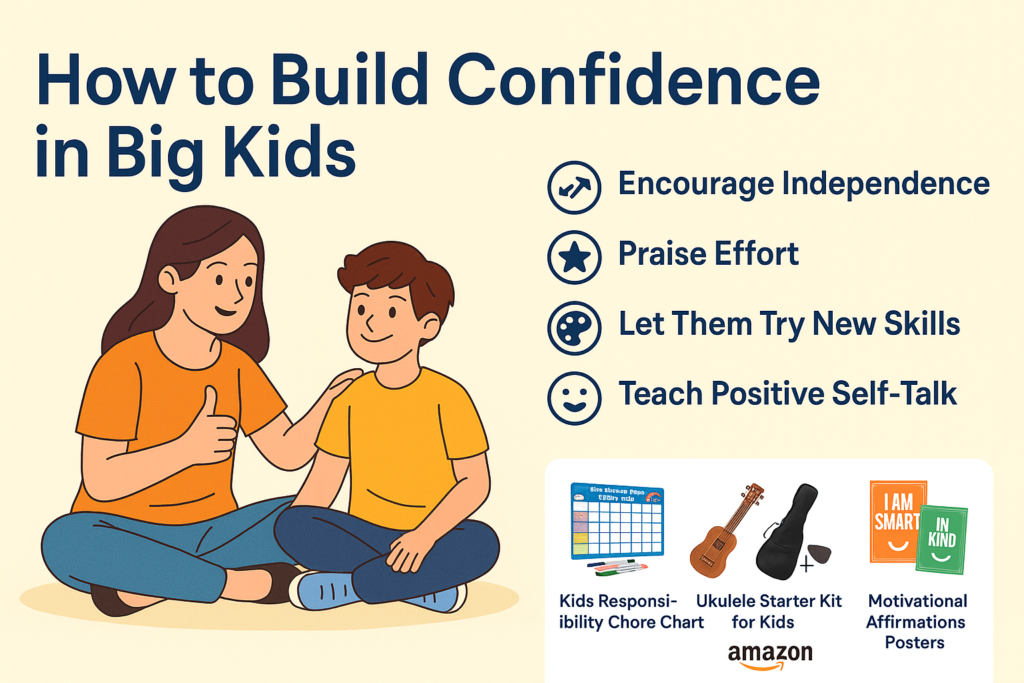
⭐ 1. Encourage Independence Through Small Responsibilities

Big kids feel proud when trusted with tasks. Start small and increase gradually — packing their school bag, helping cook, or managing pocket money. Independence builds capability, which naturally builds confidence.

Helpful Tools from Amazon:

Tip: Avoid fixing everything for them. Let them try, even if imperfect.

⭐ 2. Praise Effort, Not Just Success

When we praise outcomes only (“You got an A!”), kids may fear failure. But praising effort (“I love how hard you tried!”) builds growth mindset.

✔ Say this more: “You worked hard — that matters!”
❌ Less of: “You are the smartest!”

Book Recommendation:

External resource (DoFollow style) for reference:
👉 Growth Mindset Science for Kids — https://www.mindsetworks.com

⭐ 3. Let Them Try New Skills & Hobbies

Expose them to sports, music, art, coding, or anything they’re curious about. New skills = new confidence anchors.

Activity Ideas:
🎨 Art & Craft Kits
⚽ Soccer / Sports Set
🎸 Beginner Music Starter Kits

Amazon product ideas (natural placement):

⭐ 4. Teach Positive Self-Talk & Affirmations

Kids absorb inner voice from what they hear. Encourage statements like:

  • “I am capable.”
  • “I can learn this step by step.”
  • “Mistakes help me grow.”

Create a bedroom affirmation wall with sticky notes.

Amazon suggestion:

External helpful reference (DoFollow-style):
👉 Positive Parenting Research — https://childmind.org

⭐ 5. Allow Failure & Problem-Solving

Confidence grows when kids fall, stand back up, and try again. Instead of rushing to fix things, guide them:

“What do you think is the first step to solve this?”

Resilience > Perfection.

⭐ 6. Encourage Social Interaction & Leadership

Clubs, group activities, playdates, volunteering projects — all improve communication and belonging.

Confidence-Boosting Activities:

  • Join school clubs
  • Volunteer with community groups
  • Debate or public speaking clubs

Amazon supportive tool:

⭐ 7. Build Confidence with Routine Reflection

End the day with a 5-minute positive recap.

Ask:

  • “What made you feel proud today?”
  • “What challenge did you face and handle well?”
  • “What can you try new tomorrow?”

Journal suggestion:

📊 Quick Confidence-Building Techniques Table

Confidence BuilderDaily Time NeededAge FitResults
Praise effort30 sec6–12Resilience mindset
Chore responsibility5–10 min7–13Independence
New hobbiesWeekly7–14Skill exploration
Positive affirmations2 min/day5–12Self-worth
Reflection journalNight routine8–14Emotional growth

Final Takeaway

Learning how to build confidence in big kids is a journey — small steps every day make a lifelong foundation. Be patient, celebrate progress, and let them explore who they are. A supported child becomes a confident adult.

How to Calm a Hyperactive Child at Home in 2026

Introduction

How to calm a hyperactive child at home in 2026 is a question many parents face, especially with the increasing use of digital devices and educational technology. Hyperactivity can affect a child’s focus, learning, and behavior, but with updated strategies, routines, and modern tools, parents can help children manage energy and improve self-control. This guide provides practical techniques, educational activities, and natural strategies that reflect current trends and tools in 2026.

How to Calm a Hyperactive Child at Home in 2026

Create a Structured Routine

A structured daily routine remains one of the most effective ways to calm a hyperactive child at home in 2026. Children feel secure when they know what to expect, and modern tools can make routines more engaging.

Tips:

  • Use visual schedules or apps to help children follow routines independently.
  • Break tasks into small, manageable steps to reduce overwhelm.
  • Set clear rules and expectations, and review them regularly.

Amazon Recommendations:

Encourage Physical Activity

Physical activity is essential for hyperactive children to release energy, improve focus, and boost overall well-being. In 2026, there are even more indoor and outdoor tools to help children stay active safely.

Activity Ideas:

  • Outdoor activities: biking, running, soccer, or interactive playgrounds.
  • Indoor activities: mini trampolines, kids’ yoga sessions, or dance workouts via online apps.
  • Short activity breaks during homework or chores.

Amazon Recommendations:

Use Calming Techniques

Calming strategies are critical in 2026, especially with increased screen time and digital stimulation. Techniques help children focus, relax, and self-regulate.

Techniques:

  • Deep breathing exercises or guided breathing apps.
  • Short mindfulness or meditation sessions designed for children.
  • Quiet corner with soft cushions, calming toys, or books.
  • Relaxing music playlists tailored for children.

Amazon Recommendations:

Engage in Educational Play

Educational and interactive play can reduce hyperactivity while enhancing focus, creativity, and cognitive skills. In 2026, both physical and digital tools are available to make learning more engaging.

Ideas:

  • Puzzles for problem-solving and patience.
  • Arts and crafts to boost creativity and fine motor skills.
  • LEGO sets or building blocks to develop concentration and attention span.
  • Interactive educational apps and tablets designed for learning and focus.

Amazon Recommendations:

Maintain a Healthy Diet

A child’s diet affects energy levels and behavior. Balanced meals with proteins, whole grains, fruits, and vegetables help hyperactive children stay calm and focused in 2026.

Tips:

  • Include protein-rich snacks like yogurt, cheese, or nuts.
  • Encourage children to drink water regularly.
  • Limit sugar and processed foods that may increase hyperactivity.

Amazon Recommendations:

Educational and Behavioral Techniques

Modern behavior management in 2026 combines positive reinforcement, structured tasks, and interactive learning.

Strategies:

  1. Positive Reinforcement: Reward good behavior to encourage repetition.
  2. Task Chunking: Break tasks into smaller steps to prevent overwhelm.
  3. Interactive Learning: Use apps, games, or storytelling to teach focus and patience.
  4. Clear Limits: Consistent rules and expectations help children self-regulate.

When combined with routines, activity, calming strategies, and nutrition, these techniques create a supportive home environment for hyperactive children.

FAQ Section

Q: Can hyperactive behavior be fully controlled at home in 2026?
A: While complete elimination is unlikely, modern routines, educational tools, and calming strategies can greatly improve behavior.

Q: Are educational apps effective for hyperactive children?
A: Yes! Apps designed for 2026 focus on interactive learning, problem-solving, and attention-building.

Q: How can parents encourage calm without being strict?
A: Use positive reinforcement, structured routines, interactive play, and model calm behavior rather than punishment.

Conclusion

How to calm a hyperactive child at home in 2026 involves a combination of structured routines, physical activity, calming techniques, educational play, and nutrition. Parents who adopt these strategies can help children manage energy, improve focus, and develop healthy behaviors. Modern tools like meditation cards, fidget toys, educational apps, and learning tablets make these strategies more effective and enjoyable for both children and parents.

Screen Time Guide for Ages 3–12: Healthy Habits for Kids

Introduction Screen Time Guide for Ages 3–12

In today’s digital world, managing screen time has become a crucial part of parenting. A screen time guide for ages 3–12 helps parents balance fun, learning, and safety. Proper screen habits can enhance your child’s development, creativity, and learning while reducing the risks of overexposure.

This guide covers recommended limits, educational tools, tips for healthy usage, and Amazon products that parents trust.ing educational tools and Amazon products that make screen time productive and engaging.

Screen Time Guide for Ages 3–12: Healthy Habits for Kids

According to the American Academy of Pediatrics (AAP):

AgeRecommended Screen Time
3–5 years1 hour per day (high-quality content)
6–12 yearsConsistent limits, encourage balance with other activities

Tips for Healthy Screen Time

1. Make a Daily Schedule

Set specific times for screen use. For younger children, 20–30 minute sessions multiple times a day work better than long blocks.

2. Encourage Educational Content

Choose apps and games that boost learning and creativity:

3. Co-View and Interact

Parents should occasionally join their kids during screen time to discuss content and enhance learning.

4. Balance with Offline Activities

Promote physical play, reading, and hands-on activities:

5. Create Device-Free Zones

Avoid screens in bedrooms and during meals to improve sleep and family interaction.

Educational Apps and Tools

Here are some recommended apps that combine fun and learning:

  • Khan Academy Kids – Free interactive lessons for ages 3–8.
  • ABCmouse – Reading, math, and art for ages 3–8.
  • Prodigy Math Game – Engaging math learning for ages 6–12.
  • Duolingo Kids – Fun language learning for ages 5–12.

Monitoring Tools for Parents

  • Amazon Fire Kids Tablet – Built-in parental controls to monitor usage and content.
  • Circle Home Plus – Manages and limits screen time across devices.
  • Qustodio App – Tracks usage and sets daily limits for children.

Parental Controls and Monitoring

Common Questions Parents Ask

Q: What counts as screen time?
A: All digital devices including tablets, smartphones, TVs, and gaming consoles. Focus on interactive and educational use.

Q: How do I prevent fights over screens?
A: Set clear expectations, follow a schedule, and involve your child in choosing activities.

Q: Can screen time affect sleep?
A: Yes, especially before bedtime. Avoid screens 1 hour before sleep to promote better rest.

Q: Are some screens better than others?
A: Tablets with educational apps or interactive content are better than passive TV watching.

Additional Tips for Parents

  1. Model Healthy Habits: Children learn from your screen use.
  2. Reward Non-Screen Activities: Encourage reading, sports, or crafts.
  3. Discuss Online Safety: Teach kids about privacy, cyberbullying, and safe browsing.
  4. Adapt as They Grow: Older kids may handle longer screen sessions with supervision.

Conclusion

A screen time guide for ages 3–12 helps parents manage technology in a balanced and educational way. By following these tips, monitoring usage, and providing alternative activities, screen time can be a safe, engaging, and learning-focused experience.

Your Child’s Growth Journey: A Positive Guide to Every Stage of Childhood Development 2026

INTRODUCTION A Positive Guide to Every Stage of Childhood Development

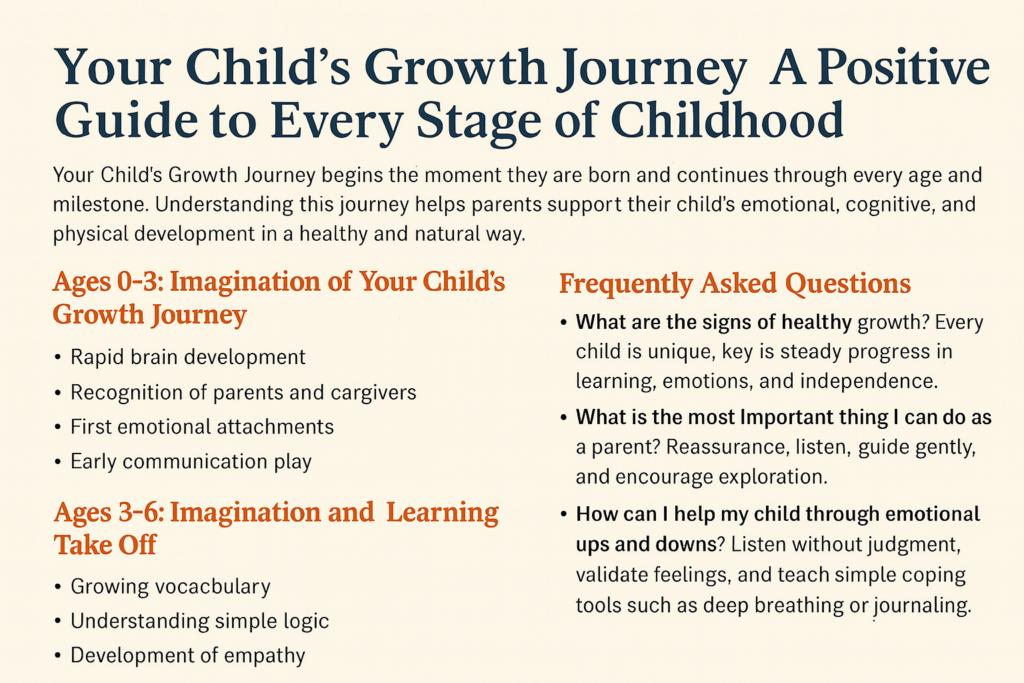
Your Child’s Growth Journey begins the moment they are born and continues through every age and milestone. Understanding Your Child’s Growth Journey helps parents support emotional, cognitive, and physical development in healthy, natural ways. Each stage of Your Child’s Growth Journey brings new skills, challenges, and learning opportunities. This guide explains these stages clearly so parents can support growth with confidence and knowledge.

Your Child’s Growth Journey: A Positive Guide to Every Stage of Childhood Development

Understanding Your Child’s Growth Journey

Children grow in four important areas: physical development, emotional development, social skills, and cognitive understanding. When parents understand these areas, they can support each stage of Your Child’s Growth Journey with patience, guidance, and consistency. Childhood growth is not about perfection—it’s about progress.

Ages 0–3: The Beginning of Your Child’s Growth Journey

The early years are full of sensory exploration, bonding, and emotional foundation. During this part of Your Child’s Growth Journey, babies learn through touching, holding, hearing, and observing.

What happens in this stage:

  • Rapid brain development
  • Recognition of parents and caregivers
  • First emotional attachments
  • Early communication through sound and expression

How parents can support:

  • Talk, sing, and read daily
  • Respond to cues with warmth
  • Offer safe sensory toys
  • Maintain predictable routines

Helpful educational tool (natural link):
Soft Sensory Books → https://amzn.to/4h0UkB4

Ages 3–6: Imagination and Learning Take Off

This stage of Your Child’s Growth Journey is built on curiosity, creativity, and emotional expression. Children begin to understand feelings, ask questions, and explore through pretend play.

What happens in this stage:

  • Growing vocabulary
  • Understanding simple logic
  • Development of empathy
  • Strong imaginative play

How parents can support:

  • Encourage storytelling
  • Allow pretend play
  • Name emotions and talk about feelings
  • Offer simple problem-solving activities

Helpful educational tool (natural link):
Pretend Play Kitchen → https://amzn.to/3CM2Kjek

Ages 6–9: Skill-Building and Confidence

This part of Your Child’s Growth Journey is marked by increasing confidence and intellectual growth. Children begin reading more fluently, understanding rules, and enjoying teamwork.

What happens in this stage:

  • Stronger memory and logic
  • Interest in group play and teamwork
  • Developing independence
  • Expanding academic skills

How parents can support:

  • Read daily and discuss stories
  • Encourage STEM activities
  • Praise effort over perfection
  • Allow kids to take small responsibilities

Helpful educational tool (natural link):
STEM Starter Kit → https://amzn.to/3CYjJ6a

Ages 10–14: Emotional Growth and Independence

This is one of the most important stages of Your Child’s Growth Journey, where emotions deepen, identities form, and independence grows. Children begin to understand themselves better and seek autonomy.

What happens in this stage:

  • Advanced reasoning
  • Big emotional changes
  • Stronger friendships
  • Increased desire for independence

How parents can support:

  • Communicate gently and openly
  • Encourage hobbies like coding, journaling, or sports
  • Listen without judgment
  • Guide decision-making with patience

Helpful educational tool (natural link):
Coding Robot Kit → https://amzn.to/4hxV5HG

Everyday Moments Matter in Your Child’s Growth Journey

One of the most natural parts of Your Child’s Growth Journey is how much learning happens during normal daily activities. Cooking teaches math and responsibility. Reading strengthens imagination. Play teaches cooperation, patience, and problem-solving.

Parents support growth by turning everyday life into opportunities to learn, connect, and explore.

Emotional Development Throughout the Journey

Emotional intelligence is essential in Your Child’s Growth Journey. Children must learn how to name their feelings, express themselves, and handle challenges. Parents help by staying calm, listening closely, offering reassurance, and modeling emotional control.

Building Life Skills Step by Step

As Your Child’s Growth Journey progresses, life skills develop naturally:

  • Young children learn routines and sharing
  • School-aged kids learn responsibility
  • Older kids learn decision-making and independence

These skills shape confidence and future success.

Final Thoughts

Your Child’s Growth Journey is unique, meaningful, and constantly changing. With patience, understanding, and gentle guidance, parents can support their child at every stage. You don’t need to be perfect—just present. Each moment spent listening, teaching, and encouraging leaves a lasting impact on your child’s future.

🧸 Toddlers & Preschoolers: The Ultimate 2025 Parenting Guide

Raising toddlers & preschoolers is a joyful yet challenging journey. From understanding toddler development to planning preschool activities, this guide provides parents with actionable tips to support healthy growth, learning, and emotional well-being.

Tracking toddler development milestones helps parents ensure children grow on schedule. Key areas include:

  • Physical Skills: Walking, running, climbing, and fine motor skills.
  • Cognitive Skills: Language growth, memory, and problem-solving.
  • Social & Emotional Skills: Sharing, empathy, independence, and emotional expression.

Fun Preschool Activities & Learning Games

Engaging in preschool activities boosts brain development, social skills, and creativity:

  • Sensory Play: Sand, water, or clay enhances fine motor skills.
  • Storytime & Reading: Improves language, comprehension, and imagination.
  • Educational Games: Counting, sorting, and matching games support cognitive growth.
  • Outdoor Play: Develops gross motor skills and encourages social interaction.

Nutrition Tips for Toddlers & Preschoolers

A healthy diet is vital for toddler development:

  • Fruits & Vegetables: Provide vitamins and fiber.
  • Proteins & Whole Grains: Support energy and growth.
  • Healthy Snacks: Limit sugar, offer yogurt, fruits, or nuts.
  • Hydration: Encourage water consumption over sugary drinks.

Sleep & Routine Guidance

Proper sleep supports growth, mood, and learning:

Bedtime Routine: Bath, storytime, and calm activities promote restful sleep.

Toddlers (1–3 years): 11–14 hours (including naps).

Preschoolers (3–5 years): 10–13 hours (including naps).

Safety & Parenting Tips

Childproof Your Home: Secure stairs, sharp edges, and small objects.

Hygiene Habits: Teach handwashing, teeth brushing, and self-care.

Positive Reinforcement: Praise good behavior instead of punishment.

Parental Engagement: Participate in activities to boost confidence and learning.

Encouraging Early Learning & Curiosity

Introduce letters, numbers, and colors through play.

Use open-ended questions to encourage thinking.

Explore art, music, and nature to foster creativity.

🧩 Toddlers vs Preschoolers: Key Milestones & Activities

Age GroupKey Development MilestonesRecommended ActivitiesFocus Areas
1–2 Years (Toddlers)Walking, climbing, first words, hand-eye coordinationSensory play, stacking blocks, simple puzzles, storytimePhysical skills, language development, motor skills
2–3 Years (Toddlers)Running, speaking in short sentences, following simple instructionsFinger painting, matching games, sing-alongs, outdoor playCognitive skills, social interaction, creativity
3–4 Years (Preschoolers)Counting, identifying colors & shapes, sharing, self-dressingArts & crafts, educational games, pretend play, storytellingEarly learning, social skills, fine motor skills
4–5 Years (Preschoolers)Writing letters, advanced vocabulary, teamwork, problem-solvingNumber games, board games, music & dance, nature explorationCognitive growth, emotional intelligence, social development

Frequently Asked Questions (FAQ)

Q1: What are key developmental milestones for toddlers & preschoolers?
A: Physical, cognitive, and social skills — walking, language, sharing, and problem-solving.

Q2: How can I support early learning?
A: Use preschool activities, educational games, storytime, and outdoor play.

Q3: What is the ideal sleep routine?
A: Toddlers: 11–14 hours. Preschoolers: 10–13 hours. Consistent bedtime routines help.

Q4: How can I ensure proper nutrition?
A: Provide balanced meals with fruits, vegetables, proteins, and whole grains. Limit sugar.

Q5: How do I choose safe activities?
A: Childproof your home, supervise play, and encourage exploration in safe environments.

🏁 Conclusion: Raising Healthy Toddlers & Preschoolers in 2025

In the 2025 parenting guide for toddlers & preschoolers, we’ve covered toddler development, preschool activities, nutrition, sleep routines, and safety tips. By applying these strategies, parents can help children grow healthy, happy, and confident.